
Ten years ago, a typical Employee Assistance Program meant a laminated poster on a staff room wall — a helpline number that most employees never called. Today, the stakes are far higher. Mental health-related sick leave costs UK employers an estimated £56 billion every year (Deloitte). Presenteeism — the hidden cost of employees showing up while struggling — accounts for the majority of that figure. For every forward-thinking HR leader, the question is no longer whether to offer support, but how proactively that support is delivered.
So, what is an employee assistance program, exactly? An EAP is an employer-funded service that gives every team member confidential access to professional support — covering mental health, financial wellbeing, legal advice, and physical health — at zero personal cost to the employee. But where a traditional EAP sat quietly in the background, a modern workplace wellbeing platform actively engages employees before a crisis ever develops. That proactive shift is the difference between a benefit employees forget and one they actually use.
At Spark Your Health, we have built the bridge between compassionate employee care and measurable business outcomes. Investing in a modern EAP is one of the most effective strategies to maximise workplace wellness programs and see a measurable return on investment. Read on to see exactly how.
| Book Your Free Wellbeing Consultation TodaySpeak to a specialist. No obligation — just expert guidance for your organisation.📧 info@sparkyourhealth.co.uk 📞 0843 289 3468 |
Quick Answer: What Is an Employee Assistance Program?
| An Employee Assistance Program (EAP) is a confidential, employer-funded service providing professional support across four pillars: mental health counselling, financial wellbeing advice, legal guidance, and physical health. Available 24/7 via a confidential staff helpline or digital app, an EAP gives every employee somewhere to turn — well before small pressures become serious problems. |
Transform Workplace Wellness with an EAP That Actually Reduces Absenteeism
The UK average for sickness absence sits at 7.8 days per employee per year (CIPD, 2023), with stress, anxiety, and depression accounting for the largest share of long-term leave. For a company of 100 employees, that figure represents thousands of lost working hours and significant recruitment, cover, and productivity costs — before a single appointment is booked.
A proactive eap employee assistance program intervenes far earlier in that cycle. Rather than waiting for an employee to reach breaking point, it delivers stress management resources, structured counselling, and early-access mental health support the moment pressure begins to build. Employees resolve concerns in days, not weeks — and businesses avoid the compounding costs of prolonged absence.
Without early intervention, many team members reach a point where a medical note becomes necessary. It is important for HR managers to understand how long an employee can be signed off with stress in the UK so they can plan structured support during recovery and protect the wider team from carrying additional load.
When stress goes unmanaged, businesses often have to navigate the complexities of the maximum time off for stress leave, which creates significant gaps in productivity and team morale. An EAP works best when paired with a workplace stress risk assessment to identify early signs of pressure before they lead to burnout.
What Is an Employee Assistance Program in the UK? The Four Pillars Explained
A modern workplace wellbeing platform does far more than offer a helpline. Here is a breakdown of the four core pillars that make a high-quality EAP genuinely valuable to UK employees — and commercially meaningful to the organisations that fund them.
1. Mental Health and Confidential Counselling
This is the heart of every EAP. Employees gain immediate access to structured counselling sessions — typically six to eight per presenting issue, delivered by accredited therapists. The service covers anxiety, depression, relationship difficulties, grief, and workplace conflict.
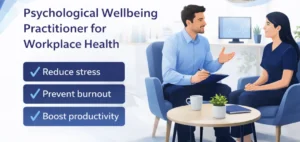
Critically, it is entirely confidential: no manager or employer ever sees individual case data. That confidentiality is the single biggest driver of genuine employee engagement with EAP services. Our programme connects employees directly to specialists, much like how a psychological wellbeing practitioner provides targeted support for mild-to-moderate mental health concerns, but at scale and on demand.
2. Financial Wellbeing Advice
The cost-of-living crisis has made financial wellbeing advice one of the most accessed EAP features in the UK. Employees receive confidential guidance on debt management, budgeting, pension planning, and benefits entitlement. Reducing financial anxiety at home translates directly into sharper focus and greater engagement at work — one of the most underestimated work-life balance tools available to employers today.
3. Legal Support for Staff
Personal legal matters — from tenancy disputes to family law questions — are a significant and often invisible source of employee stress. EAP-integrated legal support for staff connects employees with a qualified legal adviser, resolving manageable problems before they consume the employee’s mental bandwidth and begin affecting attendance and output.
4. Physical Health and Virtual GP Access
NHS waiting times remain a pressing concern for UK employees. Virtual GP access — available through the Spark Your Health platform — allows employees to speak with a doctor the same day, receive clinical advice quickly, and access physiotherapy referrals without the wait. This reduces the period where minor physical issues become extended absences, and it strengthens occupational health assessment integration across the business.
Reactive vs. Proactive: Why Your Current EAP May Be Falling Short
Research consistently shows that traditional EAPs achieve engagement rates of less than 5% of the workforce. Most employees either do not know the service exists, do not trust it, or only reach out once they are already in crisis. This is the reactive model — and it is expensive for everyone involved.
The Spark Your Health digital EAP platform operates on a fundamentally different model. Our mobile-first wellness app places counselling booking, self-assessment tools, and wellbeing content directly in every employee’s pocket. Regular manager-facing staff engagement metrics keep HR leaders informed about usage trends without ever compromising individual confidentiality. The platform becomes part of daily working life — not a last resort.
The difference between a traditional EAP and a modern wellness platform is this: a traditional service waits for the employee to reach out. A modern platform meets employees where they are, before a problem has fully formed. This shift from crisis intervention to proactive daily engagement is what drives the measurable outcomes that UK decision-makers need to see — and what underpins a credible corporate mental health strategy.
| See the Spark Your Health Platform in ActionRequest a free 30-minute demo and discover what a proactive EAP looks like for your team.📧 info@sparkyourhealth.co.uk 📞 0843 289 3468 |
The Business Case: Costs, Compliance, and Culture

Is an EAP Mandatory in the UK?
Strictly speaking, no — but the legal picture is more nuanced than a simple answer. Under UK health and safety legislation, every employer carries a duty of care towards the mental and physical wellbeing of their staff. The Health and Safety at Work Act 1974, combined with the Management of Health and Safety at Work Regulations 1999, requires employers to assess and address work-related stress. An EAP is not named as a statutory requirement, but failing to provide adequate support — and subsequently facing a tribunal or HSE investigation — is a far costlier outcome. Most employment law specialists recommend an EAP as the most practical demonstration of duty of care compliance in the UK.
How Much Does an Employee Assistance Program Cost in the UK?
The most common UK pricing model is a cost-per-employee-per-month (PEPM) structure. Depending on the services included, this typically ranges from £1 to £8 per employee per month for a comprehensive digital platform. For context, the average cost of replacing a single UK employee exceeds £3,000 once advertising, onboarding, and lost productivity are factored in. Improving employee retention by even a few percentage points through a well-implemented EAP delivers a positive workplace wellness ROI within the first year of deployment.
Ultimately, a proactive EAP is the foundation of wellbeing in the workplace — ensuring employees feel supported both professionally and personally. That investment pays back through lower absenteeism, stronger retention, and a more compelling employer proposition in an increasingly competitive UK talent market.
How to Implement a Modern EAP with Spark Your Health
Rolling out a new wellbeing platform does not need to be complicated. Here is how Spark Your Health clients consistently achieve a high-engagement launch.
Step 1: Secure Leadership Buy-In
Present the business case using hard numbers: absenteeism cost per employee, recruitment costs, and ROI benchmarks from comparable UK organisations. Visible leadership support signals to every team member that wellbeing is a strategic priority — not a compliance exercise.
Step 2: Launch the Platform with Intention
A quiet email is not enough. Effective rollouts combine a company-wide announcement with team briefings, manager toolkits, and clear communication about how to access the 24/7 mental health support service. Employees need to know it exists, how to use it, and that it is completely confidential.
Step 3: Monitor, Report, and Refine
Spark Your Health provides HR leaders with regular reporting on usage and engagement — without compromising individual privacy. These insights allow you to spot trends, such as a spike in financial wellbeing queries following organisational change, and address root causes early. A well-implemented EAP is a living component of your corporate wellbeing programs — not a set-and-forget policy document.
People Also Ask: Your EAP Questions Answered
These are the questions UK HR managers and business leaders ask most frequently — answered clearly.
What are the 3 main benefits of an Employee Assistance Program?
The three headline benefits are: (1) reduced absenteeism and presenteeism through early mental health support; (2) improved employee retention and morale by demonstrating genuine organisational care; and (3) actionable HR wellbeing insights that allow leadership teams to address systemic workplace stressors before they escalate into costly long-term sick leave.
Do employees have to pay to use an EAP?
No. An EAP is entirely employer-funded. Every service — from counselling and legal advice to virtual GP access and financial guidance — is provided at zero personal cost to the employee. Removing cost as a barrier to accessing support is the first and most important step to genuine engagement.
Can my employer find out if I have used the EAP?
No. Confidentiality is the cornerstone of every credible EAP. Employers receive only anonymised, aggregated data — such as the total number of users in a given period — never individual names or case details. This confidentiality is what allows employees to speak openly, and it is precisely what makes the service clinically effective.
How does an EAP differ from Occupational Health?
Occupational Health (OH) is a clinical assessment service, typically engaged after an employee has already been absent. It is employer-commissioned and reports are shared with management. An EAP, by contrast, is employee-initiated, entirely confidential, and designed to prevent the need for OH intervention in the first place. The two services work best in tandem: an EAP as the proactive daily layer, and OH as the structured clinical response when longer-term absence has already occurred.
The Competitive Advantage of a Healthy, Well-Supported Team
A well-implemented Employee Assistance Program is not a cost — it is a strategic investment in the most valuable asset your business holds: its people. The evidence is consistent. Organisations that commit to proactive workplace wellbeing report lower absenteeism, stronger retention, higher productivity, and a significantly more attractive employer brand in a competitive talent market.
The NHS consistently highlights that access to confidential, professional support is linked to better long-term mental health outcomes. Embedding that access into your workplace — through a modern, digital, always-on EAP — is the most impactful step UK businesses can take this year to protect both their people and their performance.
If you are ready to move beyond the reactive model and build a genuinely proactive culture of care, Spark Your Health is ready to help. Explore our employee wellness program today and take the first step towards a healthier, higher-performing team.
| Ready to Build a Healthier, Higher-Performing Team?Book your free consultation with Spark Your Health specialists today. No obligation.📧 info@sparkyourhealth.co.uk 📞 0843 289 3468 |