

An occupational health assessment UK is a role-specific employee health assessment UK that helps employers understand whether someone is medically fit to do their job safely and what support or adjustments may be needed. It’s often used alongside a GP fit note, because occupational health focuses on job demands and workplace risk. Where exposure risk exists, it may sit alongside health surveillance UK employer checks.
Want a simple, compliant process for referrals, reports and adjustments?
Call 0843 289 3468 or email info@sparkyourhealth.co.uk to request an employer occupational health review.
What is an occupational health assessment UK?
A workplace health check is commonly delivered as an occupational health assessment UK. It’s not a general GP appointment. It is a structured review that looks at:
- the employee’s functional ability (what they can safely do)
- the job’s demands and any workplace exposure risks
- support needed to work safely (including reasonable adjustments occupational health)
In practical terms, an employee health assessment UK answers one business-critical question: “Is this person fit for work in this specific role and environment?”
Occupational health assessment for employers: when should you use one?
Employers usually request an occupational health assessment for employers when health could affect performance, safety, attendance or compliance. Common triggers include:
- long-term sickness absence or repeated short-term absence patterns
- return-to-work planning after injury, surgery, or mental health-related leave
- safety-sensitive roles where risk is higher (driving, operating plant, working at height)
- workplace stress concerns where support and adjustments are needed
Realistic example: A line manager notices an employee has had three short absences in two months and is struggling with concentration in a safety-sensitive role. HR makes an occupational health referral UK to confirm fitness for work and identify adjustments before an incident occurs.
When stress is part of the case, reference your legal responsibilities using this anchor exactly: Employers’ Duty of Care for Workplace Stress UK.
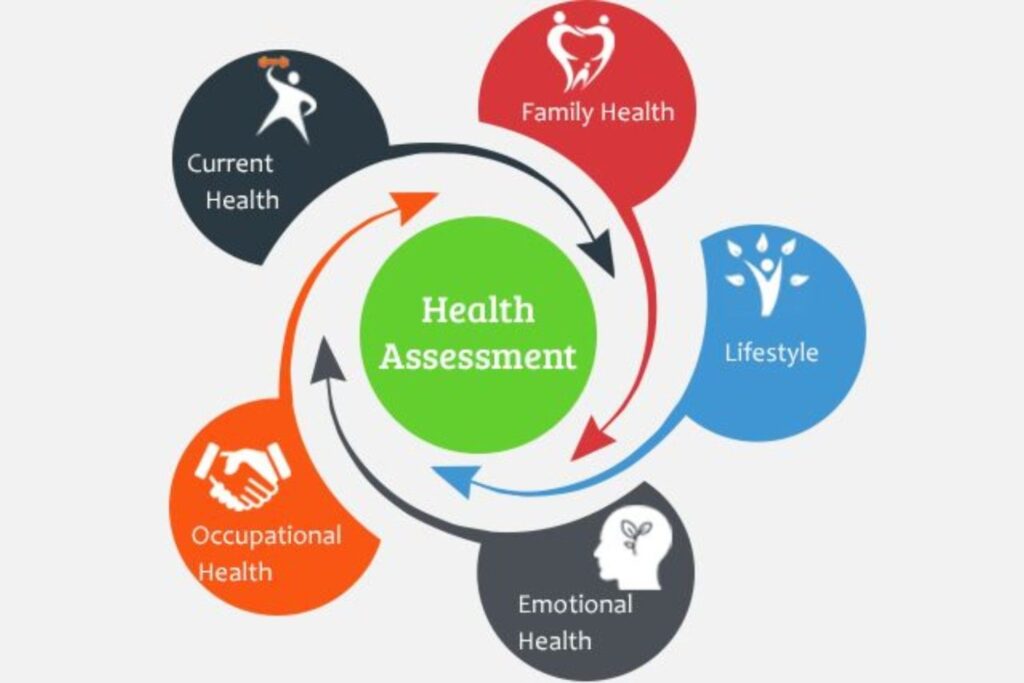
What happens during occupational health screening UK appointments?
Most occupational health screening UK appointments follow a similar structure:
- Pre-assessment questionnaire (health history relevant to work)
- Role and risk review (job tasks, exposures, shift patterns, workload)
- Work impact discussion (symptoms, limitations, triggers, what helps)
- Targeted checks only if needed (not always a “medical test day”)
- Report to employer with functional recommendations
Realistic examples of targeted checks (role-driven):
- Manual handling roles: functional capability and musculoskeletal assessment
- Driving/transport: fatigue, concentration, sleep pattern risk review
- Dust/chemical exposure environments: respiratory screening considerations
- Noise exposure roles: hearing protection compliance and audiometry needs
Fitness for work assessment UK: what outcomes apply?
A fitness for work assessment UK usually ends with one of three outcomes that employers can act on:
- Fit for work
- Fit for work with adjustments (temporary or ongoing)
- Temporarily unfit (with a review date / staged plan)
Which outcome applies (realistic examples):
- Fit: office-based role, minor symptoms, no safety risk, self-managed treatment plan
- Fit with adjustments: warehouse role with back pain → reduced lifting, mechanical aids, modified duties for 4–6 weeks
- Temporarily unfit: safety-critical operator after medication change causing drowsiness → removed from safety-critical tasks until stable, review in 2–4 weeks
Occupational health report to employer: what employers receive (and what they don’t)
An occupational health report to employer is designed to support safe decisions, not share private clinical detail. Employers typically receive:
- functional capability statement (work capacity, restrictions)
- recommended reasonable adjustments occupational health
- likely timescales and review recommendations
- guidance on return-to-work planning
Employers generally do not receive full medical history or diagnosis unless the employee provides explicit consent.
If you want a related behavioural guidance piece, link here using this anchor exactly: What Not to Say to Occupational Health UK.
Reasonable adjustments occupational health: practical examples (by role)
Good reasonable adjustments occupational health are specific, measurable, and time-bound. Examples employers commonly implement:
Office / knowledge work
- adjusted start/finish times for fatigue or treatment schedules
- ergonomic workstation changes and posture breaks
- temporary workload re-prioritisation and protected focus time
Operations / manual roles
- modified duties (reduced lifting, alternative tasks)
- assistive equipment (trolleys, lifting aids)
- additional breaks or micro-break structure during recovery periods
Shift / high-demand roles
- temporary rota changes (avoid nights during recovery)
- phased return-to-work schedule (hours and duties increase weekly)
- buddying / supervision where safety risk exists
Realistic example: A phased return plan after stress-related absence: Week 1: 50% hours (no overtime) → Week 2: 70% hours → Week 3: full hours, with a formal review point.
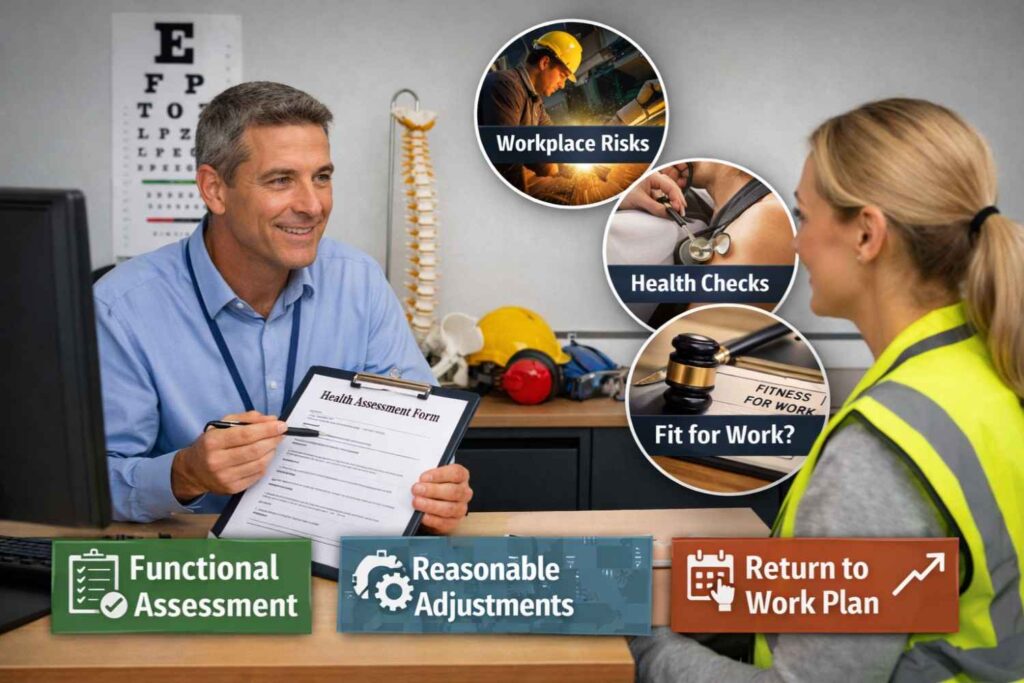
Return to work assessment occupational health: preventing repeat absence
A return to work assessment occupational health is most valuable when it produces a clear plan that reduces relapse and supports performance. Employers should aim to leave the process with:
- defined work restrictions (what to avoid, for how long)
- support plan (manager check-ins, workload pacing, role changes)
- review date (so the plan doesn’t drift indefinitely)
If the return plan includes proactive wellbeing steps, link here using this anchor exactly: Wellness Action Plan UK Workplace.
For context on stress absence patterns your HR team may already be seeing, you can reference this related guide: How Long Can You Be Signed Off With Stress UK.
Health surveillance UK employer: when it applies (and how it differs from assessments)
Health surveillance UK employer is not the same as a one-off occupational health assessment. The HSE describes health surveillance as repeated health checks to identify ill health caused by work, and it’s required when workers remain exposed to health risks even after controls are in place.
Typical exposure risks that may require health surveillance: noise, vibration, and substances hazardous to health (among others), depending on your risk assessment and exposure profile.
For a dedicated explainer, link here using this anchor exactly: What Is Health Surveillance in the UK & Workplace Guide.
Safety critical medical UK: what changes for high-risk roles
A safety critical medical UK goes beyond a general capability discussion. The bar is higher because the consequences of impairment are higher. In safety-critical roles, an assessment commonly focuses on:
- alertness, fatigue risk, and concentration
- functional ability under real role demands
- fitness stability and review timelines
Realistic example: A transport operator returning after a health event may be assessed for fitness stability and safe return conditions before resuming full safety-critical duties.
Occupational health confidentiality UK: what HR can and can’t see
Occupational health confidentiality UK is a trust issue and a compliance issue. Employers should expect to receive functional recommendations rather than detailed diagnosis unless consent is provided. This approach aligns with data protection expectations around workers’ health data being sensitive (“special category”) information.
Employer best practice:
- tell the employee what information will be shared (function/adjustments)
- limit access to OH reports (need-to-know only)
- document decisions based on function, not assumptions
Occupational health referral UK: a simple employer workflow (that actually works)
When employers treat the referral as a structured process, outcomes are clearer and faster.
Step 1: Define the referral trigger
- absence thresholds, performance/safety concerns, or return-to-work planning
Step 2: Capture role demands (brief but specific)
- core tasks, physical demands, shift pattern, exposures, safety-critical elements
Step 3: Ask the right questions (copy/paste)
- Is the employee fit for work in this role?
- Is this a fitness for work assessment UK outcome: fit / fit with adjustments / temporarily unfit?
- What reasonable adjustments occupational health are recommended, and for how long?
- Is a return to work assessment occupational health plan needed?
- Is health surveillance UK employer indicated due to role exposures?
Step 4: Implement and review
- apply adjustments, schedule a review, and document outcomes
If you want a consistent referral-and-review process across departments, request an employer occupational health review.
Call 0843 289 3468 or email info@sparkyourhealth.co.uk.
Frequently Asked Questions
1) What is an occupational health assessment UK and what does it include?
An occupational health assessment UK is a role-specific employee health assessment UK. It typically includes a confidential questionnaire, role/risk review, work-impact discussion, and an occupational health report to employer with functional recommendations and adjustments.
2) When should employers use an occupational health assessment for employers?
Use it when health may affect work safety, capability, attendance, or return-to-work planning. It’s also useful when an occupational health referral UK is needed to guide reasonable adjustments.
3) What happens during occupational health screening UK appointments?
Most occupational health screening UK appointments include a questionnaire, job demands review, discussion of symptoms and impact, and targeted checks only where relevant. The outcome is a report with functional recommendations.
4) What does a fitness for work assessment UK outcome mean for HR?
It gives HR an actionable decision framework: fit, fit with adjustments, or temporarily unfit with review. It should be implemented through documented adjustments and a review date.
5) What should an occupational health report to employer include?
Functional capability, recommended reasonable adjustments occupational health, timescales, and review points. It should avoid unnecessary clinical detail unless consent is provided.
6) What are reasonable adjustments occupational health examples for common roles?
Examples include phased return schedules, modified duties, rota changes, ergonomic changes, workload pacing, and safety supervision where required.
7) When is a return to work assessment occupational health recommended?
When absence has been significant, relapse risk is high, or job demands are safety- or performance-critical. The goal is a practical plan that prevents repeat absence.
8) When does health surveillance UK employer apply?
Health surveillance UK employer applies where workers remain exposed to health risks even after controls, based on your risk assessment and exposure profile.
9) What is a safety critical medical UK and who needs it?
A safety critical medical UK is used for roles where impairment could cause serious harm (for example, certain transport, construction, rail or heavy manufacturing functions). The threshold for fitness and review is typically stricter.
10) How does occupational health confidentiality UK work in practice?
Employers receive functional recommendations and adjustments. Detailed medical history or diagnosis is typically not shared without explicit consent. Access should be restricted to need-to-know stakeholders.
11) How do we create a strong occupational health referral UK?
Include role demands, exposure risks, and clear questions: fitness outcome, suggested adjustments, return-to-work plan, and whether health surveillance is indicated.
12) Is an employee health assessment UK different from occupational health screening UK?
They often overlap in common usage. In practice, both refer to a role-focused occupational health process that results in functional recommendations for safe work and adjustments.
References (UK guidance)
- HSE: Occupational health overview and employer duty to prevent ill health (risk assessment-led)
- HSE: Health surveillance – when it is required
- HSE: Work-related stress risk assessment and Management Standards approach
- Acas: Using occupational health at work and how assessments support employer decisions
- ICO: Workers’ health information and special category data principles