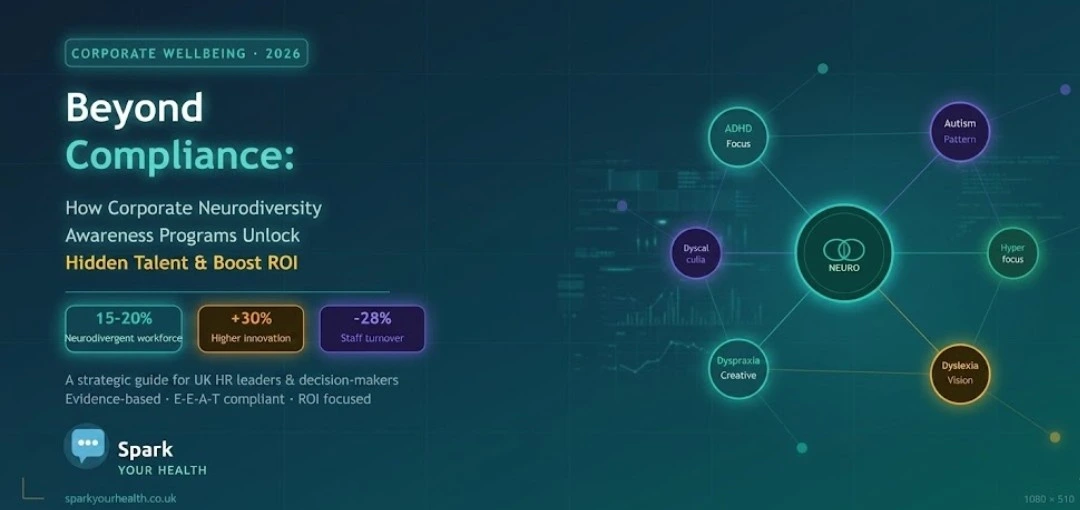
Fifteen to twenty percent of your UK workforce is neurodivergent. Standardised office culture is silently costing you their best work — and your bottom line. Here is how forward-thinking organisations are turning awareness into competitive advantage.
Quick Answer — What You Need to Know
Corporate neurodiversity awareness programs are structured, organisation-wide initiatives that educate managers and employees about neurodivergent conditions — such as ADHD, Autism, Dyslexia, and Dyspraxia — and then embed policy changes, environmental adjustments, and cultural shifts to help every cognitive style thrive.
When implemented correctly, these programmes measurably reduce absenteeism, accelerate innovation, and deliver a documented return on investment. They are no longer optional goodwill gestures. In 2026, they are a strategic business imperative for any UK employer serious about talent retention and growth.
Need a programme now? Call us on 0843 289 3468 or email info@sparkyourhealth.co.uk — our team typically responds within one business day.
The Silent Shift: Why Your Standard Office Model Is Failing 1 in 5 Employees
Picture a high-performing analyst at a mid-sized London firm. She consistently delivers the most creative risk models on the team, yet she misses every Monday morning meeting because the open-plan office leaves her exhausted before 10 a.m. Within eighteen months, she resigned. Her manager calls it a “culture fit” issue. The real issue? An undiagnosed sensory processing difference that a single environmental adjustment could have resolved.
This scenario plays out thousands of times each year across the UK. According to the CIPD and Office for National Statistics data, an estimated 15–20% of the UK population is neurodivergent, encompassing conditions including Autism Spectrum Condition, ADHD, Dyslexia, Dyspraxia, Tourette’s, and Dyscalculia. Yet the vast majority of British workplaces still design their cultures, recruitment processes, and physical spaces for a narrow neurotypical norm — and they pay for it through higher staff turnover, lost productivity, and stalled innovation.
The good news is that the most progressive UK employers have already moved beyond this model. They have discovered that corporate neurodiversity awareness programs are not simply a compliance exercise or a tick-box HR initiative. They are one of the most powerful and measurable tools available for unlocking hidden talent, strengthening teams, and generating a genuine return on investment. This guide explains exactly how — and how Spark Your Health can help you get there.
15–20%
of UK workforce is neurodivergent (CIPD, 2024)
£1,300
average annual cost of lost productivity per unsupported neurodivergent employee
72%
of neurodiverse employees feel their strengths are not recognised at work (Autistica, 2023)
+30%
higher innovation output in cognitively diverse teams (Deloitte, 2022)
The Neurodiversity Dividend: The Business Case You Cannot Ignore in 2026
Let us be direct. The organisations winning the war for talent right now are not doing so by offering the highest salaries. They are winning by building cultures where every type of mind can contribute at its best. The economic benefits — what researchers are increasingly calling the Neurodiversity Dividend — are substantial and well-documented.
Cognitive Diversity in Leadership Drives Better Decisions
Deloitte’s landmark research found that teams with high cognitive diversity solve complex problems up to 30% faster than homogeneous groups. ADHD minds, for instance, are wired for hyperfocus, rapid ideation, and risk-detection under pressure — qualities that are worth their weight in gold in product development and crisis management. Autistic professionals frequently demonstrate extraordinary pattern recognition, precision, and an ability to spot systemic inconsistencies that neurotypical colleagues overlook entirely. Dyslexic thinkers are disproportionately represented in entrepreneurship and design precisely because their brains are built for big-picture, spatial, and lateral thinking.
These are not anecdotal observations. JPMorgan Chase’s Autism at Work programme reported that participants were 90–140% more productive than neurotypical colleagues in certain quality-control roles. SAP’s Autism Inclusion Programme showed similar gains, while simultaneously improving team morale and retention across all employees — not just those who are neurodivergent. This is the power of neurodivergent talent acquisition strategies that go beyond tokenism.
Reducing Employee Turnover Through Inclusion
Replacing an experienced employee costs between 50% and 200% of their annual salary, depending on seniority. Neurodivergent employees who feel unsupported leave at significantly higher rates than their supported counterparts. A well-designed awareness programme directly addresses the conditions that drive this turnover — inconsistent management, inaccessible communication styles, and environments that cause daily cognitive overload. Reducing employee turnover through inclusion is not a soft goal. It has a precise financial value, and it compounds year on year.
If you are building a modern employee wellness programme and neurodiversity is not explicitly part of the strategy, you are leaving a significant portion of your workforce without meaningful support — and your competitors are noticing.
Ready to Build Your Neurodiversity Programme?
Spark Your Health designs bespoke, evidence-based programmes for UK businesses of all sizes. Let’s start with a no-obligation discovery call.
📞 0843 289 3468 | ✉️ info@sparkyourhealth.co.uk
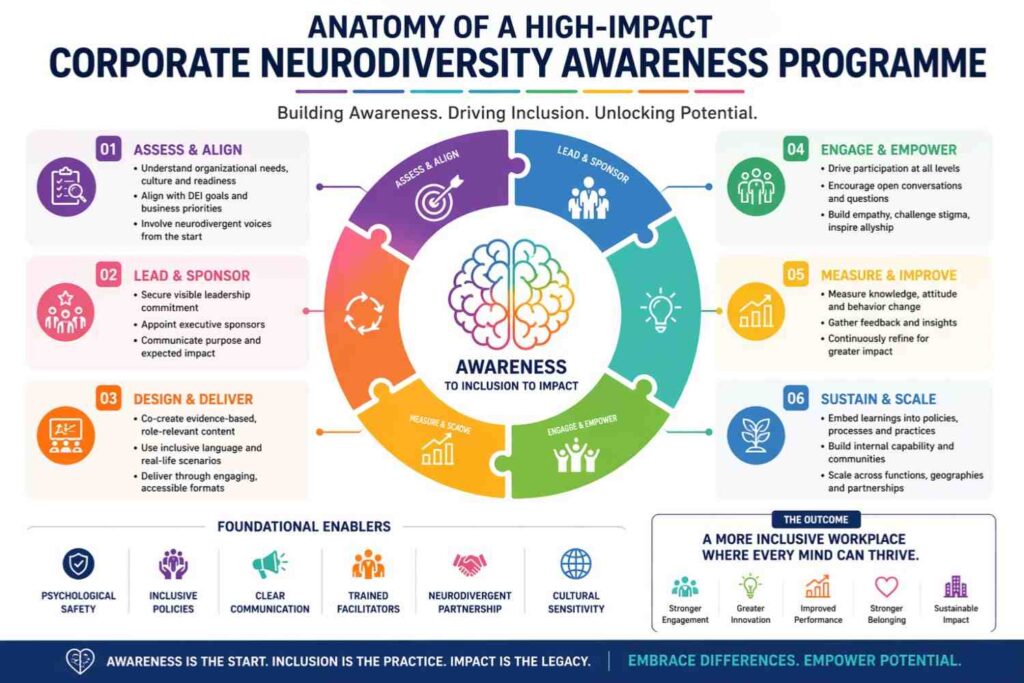
Anatomy of a High-Impact Corporate Neurodiversity Awareness Programme
One-hour lunch-and-learn sessions are well-intentioned. They are also almost entirely ineffective on their own. A corporate neurodiversity awareness programme that genuinely shifts culture and delivers measurable ROI is built on four interconnected pillars. Let us walk through each one.
Pillar 1: Organisational Audit and Baseline Assessment
Before you can fix the problem, you need to understand its shape within your specific organisation. A neurodiversity audit examines your recruitment materials, interview processes, onboarding procedures, physical workspace, HR policies, and communication norms through a neuro-inclusive lens. It identifies where your current environment inadvertently creates friction for neurodivergent employees — and where hidden disabilities at work may be going unrecognised and unaddressed.
This audit forms the evidence base for everything that follows. Without it, programmes tend to address symptoms rather than root causes, which is why so many well-meaning initiatives fail to produce lasting change.
Pillar 2: Neuro-Inclusive Recruitment Processes
Standard interview formats — timed, face-to-face, multi-question rapid-fire sessions — are structurally disadvantageous for many neurodivergent candidates. The irony is that these formats often screen out precisely the talent that would excel in the role. Neuro-inclusive recruitment means providing questions in advance, offering alternative interview formats, removing arbitrary time pressure, and evaluating candidates on demonstrated skills rather than social performance.
The principle underpinning this shift is the distinction between equity vs. equality in staff support: equality gives everyone the same ladder; equity gives everyone the ladder they actually need to reach the same height. This distinction should run through every element of your programme.
Pillar 3: Sensory-Friendly Office Design and Reasonable Adjustments
The physical environment is one of the most underestimated drivers of neurodivergent employee performance. Sensory-friendly office design does not mean a costly redesign. It means introducing quiet focus zones, adjustable lighting, reduced visual clutter in key work areas, and clear wayfinding signage — changes that benefit the entire workforce. Similarly, reasonable adjustments for ADHD and Autism — such as flexible working hours, written communication options, and task-management software — are legal obligations under the Equality Act 2010, but in practice they function as performance-enablement tools that boost output for everyone.
It is worth noting that the principles of Universal Design for Learning (UDL) in corporate training apply equally to the physical workspace. When you design for the edges, you improve the experience for the centre. A quieter office is more productive for neurotypical employees too.
Pillar 4: Managerial Training for Neurodiverse Teams
The most technically sophisticated policy will fail if line managers do not know how to implement it. Managerial training for neurodiverse teams is arguably the highest-leverage component of any awareness programme. It teaches leaders to recognise and work with “Spiky Profiles” — the term used to describe neurodivergent employees who have dramatic peaks of exceptional ability alongside genuine areas of challenge. A manager who understands spiky profiles stops trying to “fix” the challenge and starts structuring work to amplify the peak.
Training also covers psychological safety: how to create an environment where neurodivergent employees feel safe disclosing without fear of stigma or career penalty. Workplace psychological safety for neuraminorities is not a luxury — it is the prerequisite for accessing the cognitive diversity your organisation is already paying for.
From Awareness to Action: Practical Implementation in a UK Context
Knowing the pillars is one thing. Embedding them into a functioning organisation requires a sequenced, practical approach — especially in hybrid and remote-first workplaces where neuro-inclusive management becomes simultaneously more challenging and more critical.
The Role of Assistive Technology
Assistive technology for neurodivergent employees has advanced significantly in the last three years. Tools such as text-to-speech software, AI-powered grammar assistance, focus-management applications, and digital task planners have become affordable and mainstream. Embedding these into your standard technology stack — rather than treating them as special accommodations — normalises their use and removes the stigma of requesting them.
Platforms like the Spark Your Health app integrate seamlessly into this ecosystem, providing a single touchpoint for employees to access wellbeing resources, log how they are feeling, and connect with support — removing friction from the very moment an employee begins to struggle. This kind of neuro-inclusive health platform transforms reactive wellbeing support into a continuous, proactive system.
Supporting Neurodiverse Employees in Hybrid Settings
Remote work can be a genuine advantage for many neurodivergent employees — removing sensory overwhelm, enabling personalised environments, and providing greater control over communication pace. However, it can also exacerbate isolation, blur boundaries, and make informal support networks harder to access. Building tailored corporate wellness for remote teams means actively designing connection points, regular structured check-ins, and digital-first reasonable adjustments into your hybrid policy from the start — not as an afterthought.
The goal is neuro-distinct professional development: career growth pathways designed around what an individual does brilliantly, not what is easiest to assess on a standardised performance framework.
The Human Element: Clinical Support, PWPs, and Wellness Action Plans
Cultural awareness and structural change are essential. But they are not sufficient on their own for every neurodivergent employee. Some individuals need personalised clinical support to manage the interaction between their neurotype and the demands of their role — particularly during periods of high stress, transition, or change.
This is where professional psychological support for teams, delivered through qualified Psychological Wellbeing Practitioners (PWPs), becomes invaluable. PWPs bridge the gap between cultural policy and individual experience. They provide evidence-based, low-intensity psychological support that helps neurodivergent employees develop personalised coping strategies, navigate disclosure conversations, and manage workplace anxiety — without the waiting times associated with NHS referrals.
Alongside PWP support, every neurodivergent employee should have access to a personalised Workplace Wellness Action Plan (WAP). A WAP is a structured, collaborative document that identifies an individual’s strengths, preferred working styles, early warning signs of stress, and the specific adjustments that support their best performance. It is the practical bridge between organisational awareness and individual impact. Implementing a Workplace Wellness Action Plan takes less than an hour and can prevent weeks of burnout-related absence.
Neurodiversity as Part of Your Modern Employee Benefits Package
The organisations attracting and retaining the best people in 2026 are those who recognise that inclusion is a benefit, not a burden. When candidates see that a company has a documented neurodiversity programme — with visible leadership commitment, clear reasonable adjustments processes, and accessible mental health support — they make decisions accordingly.
Inclusion is increasingly ranked alongside salary, flexibility, and development opportunities as a top driver of job choice, particularly among the 18–35 age group. Understanding what constitutes modern employee benefits in the UK means recognising that formal neurodiversity workplace adjustments have moved from “exceptional provision” to baseline expectation for competitive employers.
“Neurodiversity is not a problem to manage — it is a portfolio of cognitive assets to strategically deploy. The companies that understand this first will dominate their sectors.”
— Spark Your Health Workplace Wellbeing Team
Overcoming Common Barriers: The Honest Conversation HR Leaders Need to Have
In our experience at Spark Your Health working with UK employers across multiple sectors, the most common barrier to implementation is not budget. It is fear. Specifically, the fear of getting terminology wrong, of inadvertently offending someone, or of opening up conversations that feel legally complex or emotionally charged.
This fear is understandable, and it is also addressable. The terminology used to describe neurodivergent conditions is evolving, and no responsible awareness programme expects managers to be clinical experts. What it does expect — and what training enables — is a willingness to listen, a commitment to learning, and the courage to have imperfect but genuine conversations.
Hidden disabilities at work are common precisely because employees do not feel safe disclosing without fear of a career penalty. Disclosure rates increase substantially when organisations demonstrate, through visible action rather than policy documents, that difference is genuinely valued. This is the culture shift that moves the needle — and it is the direct output of a well-executed corporate neurodiversity awareness programme.
Managing moments where different neurotypes clash — for example, an ADHD team member’s collaborative, spontaneous working style conflicting with an Autistic colleague’s preference for structure and predictability — is also addressed within our managerial training. The goal is not to eliminate differences⇙ but to give teams the language and tools to navigate it productively.
Future-Proofing Your Culture: The 2026 Outlook
The UK government’s disability employment gap remains one of the most persistent and costly inefficiencies in the national labour market. As legislation and workforce expectations continue to evolve, organisations that have not embedded neuro-inclusion into their culture will face growing pressure — from regulators, from candidates, and from their own employees.
But beyond compliance and risk management, the organisations that will win the next decade are those that harness cognitive diversity as a genuine strategic asset. The companies that attract the most inventive thinkers, the most determined problem-solvers, and the most loyal employees will be the ones that make it possible for every type of mind to do its best work.
Corporate neurodiversity awareness programs are the infrastructure for that future. They transform abstract commitments into daily realities — changing how managers lead, how offices feel, how candidates are assessed, and how employees experience their working lives. At Spark Your Health, we have designed our platform and services specifically to make that transformation measurable, scalable, and sustainable for UK businesses of all sizes.
The question is not whether your organisation can afford to invest in neurodiversity inclusion. The question is whether it can afford to continue without it.
Your 2026 Neuro-Inclusion Readiness Checklist
- ✔️Conducted a neurodiversity organisational audit in the last 12 months
- ✔️Reviewed recruitment materials and interview formats for neuro-inclusive barriers
- ✔️Introduced at least one sensory-friendly space or quiet zone in your office
- ✔️Delivered managerial awareness training on supporting Spiky Profiles
- ✔️Made assistive technology available as standard (not by request only)
- ✔️Offered Wellness Action Plans to all employees, not just those who disclose
- ✔️Integrated clinical wellbeing support (PWP access) into your employee benefits
- ✔️Embedded neurodiversity inclusion into your remote and hybrid working policy
- ✔️Measured and reported on neurodiversity-related wellbeing and turnover data
Frequently Asked Questions
What exactly is a corporate neurodiversity awareness programme?
It is a structured initiative that combines organisational audit, manager training, policy reform, environmental design adjustments, and ongoing clinical support to create a workplace where neurodivergent employees can perform at their best. Unlike a one-off training session, a high-impact programme is embedded into HR policy, recruitment, and management practice over time.
Is my company legally required to support neurodivergent employees?
Under the Equality Act 2010, many neurodivergent conditions qualify as disabilities, which means employers have a legal duty to make reasonable adjustments. However, the most progressive employers move well beyond legal minimums — because the business case for doing so is compelling, not just because the law requires it.
How long does it take to implement a programme?
A meaningful audit and initial manager training can be completed within six to eight weeks. Deeper policy reform and culture change typically unfolds over six to twelve months. Spark Your Health provides a phased implementation roadmap that fits around your existing HR calendar and business priorities.
What is the return on investment for neurodiversity programmes?
ROI is typically measured through reduced staff turnover, lower sickness absence, increased productivity in targeted roles, and stronger employee engagement scores. Our clients consistently report a positive ROI within the first year, with the programme costs recovered through reduced recruitment spend alone in most cases.
Can Spark Your Health support remote and hybrid UK teams?
Absolutely. Our platform is designed for the modern hybrid workforce, with digital-first reasonable adjustments, remote PWP support, and manager coaching delivered online. Whether your team is in a single London office or distributed across the UK, we build programmes that work for your actual operating environment.
What is a Wellness Action Plan and who should have one?
A Wellness Action Plan is a short, personalised document — typically two to three pages — that captures an employee’s preferred working conditions, early stress indicators, and the specific adjustments that support their performance. We recommend offering them to every employee, not just those who identify as neurodivergent. They are powerful tools for reducing burnout and improving manager-employee communication across the board.
Ready to Move Beyond Compliance?
Spark Your Health partners with UK businesses to design, implement, and measure corporate neurodiversity awareness programmes that deliver real results. Whether you are starting from zero or scaling an existing initiative, we meet you where you are.
Prefer to talk? Call us directly: 0843 289 3468
Email: info@sparkyourhealth.co.uk
Our team responds within one business day. No obligation, no pressure.
Explore more from Spark Your Health: Corporate Wellbeing Solutions | Employee Wellness Programmes