6-month NHS queues shouldn’t stand between you and feeling better. Discover how a private mental health assessment delivers expert clarity — often within days, not months.
Book Your Assessment Today
📞 0843 289 3468 | ✉ info@sparkyourhealth.co.uk
Quick Answer
A private mental health assessment is a comprehensive clinical evaluation by a qualified psychiatrist or psychologist. Unlike NHS referrals — which currently carry average waiting times of 18 weeks to over a year for specialist care — private assessments are available within days, typically cost between £395 and £525 for an initial consultation, and result in a clear, personalised treatment plan.
Reaching out for help with your mental health takes real courage. Yet for thousands of people across the UK, that courage is met not with support — but with a waiting list. According to NHS England data, over 1.8 million people were waiting for mental health services as of 2024. The Care Quality Commission (CQC) has repeatedly flagged that waits of 3 to 6 months — or longer — for a first specialist appointment are now commonplace. For many, those months of waiting mean worsening symptoms, lost productivity, and a creeping sense of hopelessness. A mental health assessment changes that equation entirely.
This guide covers everything you need to know: what the process involves, what it costs, how it compares to the NHS route, and how your employer can help foot the bill. Whether you are an individual seeking answers or an HR professional looking to support your team, this is your complete UK resource.
What Exactly Is a Private Mental Health Assessment?
A private mental health evaluation is far more than an informal conversation. It is a structured, clinical diagnostic evaluation conducted by a GMC-registered consultant psychiatrist or a chartered psychologist. The goal is not simply to put a label on your experience — it is to build a precise, evidence-based picture of your mental health so that the right support can be provided from day one.
The initial psychiatric consultation typically lasts between 60 and 90 minutes. During this time, the clinician will conduct a standardised mental health interview, drawing on internationally recognised frameworks such as the DSM-5 (Diagnostic and Statistical Manual of Mental Disorders, Fifth Edition) or the ICD-11 (International Classification of Diseases). These clinical diagnostic criteria ensure that every assessment meets the same rigorous standard, regardless of where you are seen.
To address the question many people quietly ask before booking: can I pay privately for a mental health assessment? Absolutely yes. Private mental health services are fully legal, widely available across the UK, and many are regulated by the Care Quality Commission (CQC). Choosing a CQC-regulated provider is the clearest assurance that the service meets national standards for safety and clinical governance.
Why it matters: A private assessment produces a formal clinical report — a document that can be shared with your GP, employer (with your consent), or used to access further therapy and medication. It is not a second-tier service. In many cases, it is a faster, more personalised version of exactly what the NHS would offer — without the wait.
NHS vs. Private Mental Health Assessment: An Honest Comparison
Understanding the NHS vs. private mental health assessment landscape in the UK is crucial before you decide on a route. Both pathways ultimately aim for the same outcome — your recovery — but they differ significantly in timeline, flexibility, and experience.
| Factor | NHS Route | Private Route |
| Waiting Time | 18 weeks to 12+ months for specialist care | Typically 3–7 days |
| Cost | Free at point of use | £395–£525 (initial adult or child appointment) |
| People Currently Waiting | 1.8 million (NHS England 2024) | Available immediately |
| Choice of Specialist | Assigned; limited choice | Choose your consultant by specialism |
| Appointment Duration | Often 20–30 minutes | 60–90 minutes |
| Formal Report | Letter to GP only | Comprehensive written clinical report |
| CQC Regulation | Yes | Yes (check provider) |
| Follow-up Flexibility | Structured pathway, limited choice | Flexible, self-directed |
A GP referral for a mental health specialist remains the entry point to NHS care. Your GP can refer you to the Community Mental Health Team (CMHT) or, in urgent cases, to a crisis resolution team. However, for non-emergency cases — anxiety, depression, ADHD, burnout, relationship difficulties — the queue is long. Going private allows you to bypass that queue while remaining in control of every step of the process.
It is also worth noting that a private assessment does not close the door to NHS services. Many people use a private assessment to get an initial diagnosis, then return to NHS care for ongoing treatment — using their private report to fast-track that referral.
Stop Guessing. Start Healing.
Our Employee Assistance Programme connects your team with accredited mental health professionals — often within 48 hours. Book a no-obligation call today.
📞 0843 289 3468 | ✉ info@sparkyourhealth.co.uk
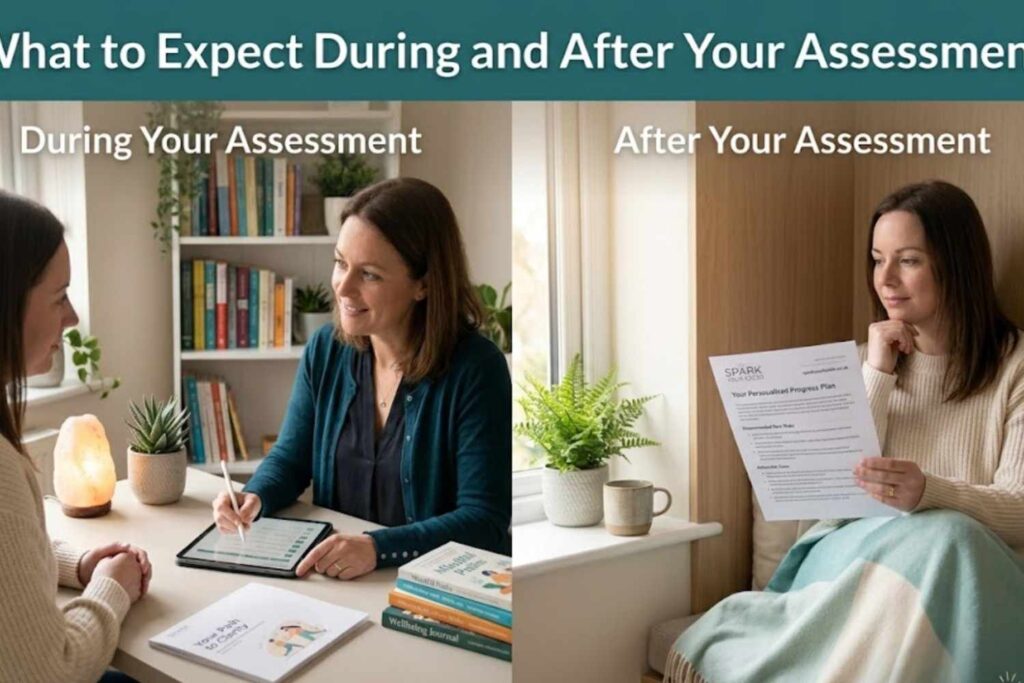
Step-by-Step: What to Expect During and After Your Assessment
Before the Appointment
Preparation makes a significant difference. In the week before your appointment, keep a simple daily log tracking your mood, sleep quality, appetite, and any triggers that affect how you feel. Note how long symptoms have been present, any medications you are taking, and any previous contact with mental health services. Arriving with this information means your clinician can spend more of the session on analysis rather than gathering basic history.
During the Assessment
The clinician will begin with open-ended questions about why you are seeking help and what your day-to-day life looks like. The standardised mental health interview that follows will cover several domains. Mood and emotional state — how often you feel low, anxious, irritable, or numb. Sleep patterns — difficulty falling asleep, staying asleep, or sleeping too much. Appetite and weight changes. Energy levels and motivation. Thoughts — including any intrusive, obsessive, or distressing thoughts. Social functioning — how your relationships and work performance have been affected.
The clinician will also ask about physical signs of stress such as headaches, muscle tension, or digestive issues — because the mind and body are not separate systems. These physical symptoms are clinically meaningful and form a core part of the evaluation.
What Happens After a Mental Health Assessment?
This is the question most people forget to ask — and arguably the most important one. Within a few days of your appointment, you will receive a formal written report. This document outlines the clinician’s findings, a working diagnosis (if one applies), and a recommended management plan. That plan may include a referral for structured therapy such as CBT or DBT, a medication recommendation, lifestyle interventions, or a combination of all three.
You will not be left to navigate next steps alone. A good private provider will discuss the report with you, answer your questions, and coordinate onward referrals where needed. After receiving your results, you can begin incorporating wellbeing exercises and mindfulness techniques into your daily routine to support symptom management while your full treatment plan is put in place.
It is also worth understanding the broader legal context. While a private assessment is a voluntary, empowering step, it is helpful to be aware that separate legal frameworks exist for more severe crises. The Section 3 Mental Health Act applies in situations requiring compulsory hospital admission — an entirely different scenario from the proactive, self-directed process of a private assessment.
The Physical Dimension: Why Assessments Go Beyond the Mind
One of the most common surprises for first-time patients is how thoroughly a private assessment addresses the body alongside the mind. This is not an oversight — it reflects current clinical evidence. Conditions such as anxiety and depression manifest not only emotionally but through a wide range of physical symptoms. Persistent fatigue, tension headaches, gastrointestinal discomfort, chest tightness, and disrupted sleep are all clinically significant indicators.
If you have been experiencing unexplained physical symptoms alongside emotional difficulties, reviewing the physical signs of stress can help you understand what to report during your consultation. Providing complete information — including physical complaints — leads to a more accurate and holistic assessment outcome.
The Workplace Angle: Why Employers Cannot Afford to Ignore This
For employers and HR professionals, mental health assessments are no longer a nice-to-have — they are a strategic business imperative. The Health and Safety Executive (HSE) reports that stress, depression, and anxiety account for more than half of all working days lost to ill health in the UK. The average cost of replacing a single employee runs into tens of thousands of pounds. Against that backdrop, funding access to a Psychological Evaluation — whether through an Employee Assistance Programme (EAP) or direct provision — is one of the highest-return investments an organisation can make.
Encouraging individual assessments should form part of a broader workplace mental health strategy that includes a formal workplace stress risk assessment. This dual approach — individual clinical support combined with organisational risk management — addresses both the symptoms and the systemic causes of poor mental health at work.
Employees who receive a formal assessment often obtain the clinical documentation needed to request reasonable workplace adjustments under the Equality Act 2010. For employers, supporting this process reduces the risk of tribunal claims and demonstrates a genuine duty-of-care commitment. If you are chronically exhausted, emotionally detached from your work, or struggling to concentrate, you may be experiencing the early signs of burnout — a recognised and treatable condition that a private assessment can formally evaluate and address.
Spark Your Health’s corporate wellbeing programmes are specifically designed to embed mental health support at an organisational level — giving your people fast access to assessments, therapy, and ongoing wellbeing resources through a single, managed solution. Our employee wellness programme integrates clinical assessment pathways with daily digital wellbeing tools, so support is available at every stage of the mental health journey.

Mental Health Self-Assessment Tools: A Useful Starting Point
If you are unsure whether a full clinical assessment is right for you right now, mental health self-assessment tools offer a valuable first step. Validated instruments such as the PHQ-9 (for depression) and the GAD-7 (for anxiety) are widely used in both NHS and private settings as screening tools. They will not replace a clinical diagnosis, but they help you articulate your experience clearly before a formal appointment.
The Spark App provides a confidential, evidence-informed wellbeing check-in that helps you track your mood, stress levels, and emotional patterns over time. It is not a diagnostic tool — but it is a powerful way to gather the kind of data that makes your clinical assessment more productive. Think of it as preparation: the clearer you are about your experience, the more targeted the clinician’s questions can be.
Before your appointment, it is also worth exploring our Mental Health First Aid Kit — a curated collection of evidence-based resources to help you manage day-to-day wellbeing while you wait for your assessment date.
Understanding the Cost: Is Private Care Worth the Investment?
The cost of a private mental health assessment in the UK typically ranges from £395 to £525 for an initial adult or child appointment with a consultant psychiatrist. Follow-up sessions are generally less expensive. Some private health insurance policies — including those provided through employer EAP schemes — cover the cost of assessment and a defined number of therapy sessions.
Set against the cost of untreated mental illness — lost working days, medication trials, relationship strain, and reduced quality of life — the financial case for early intervention is clear. A single assessment that leads to the right treatment within weeks rather than months can prevent months of avoidable suffering and lost productivity.
If you are searching for a psychiatric assessment near you, look for providers who are registered with the CQC, employ GMC-registered psychiatrists, and provide a written clinical report following the appointment. These are the non-negotiable markers of quality in private mental health care.
My Spark App: Your Daily Mental Health Companion
Not ready for a full clinical assessment yet? Download the Spark App for a confidential wellbeing check-in — free to start, evidence-informed, and available 24/7.
Taking the First Step Toward Clarity
A private mental health assessment is not about putting a label on your experience. It is about giving your experience a name, a context, and — crucially — a roadmap forward. For too long, the idea of seeking help has been tangled up in fear: fear of what you might find out, fear of being judged, fear of being put on yet another waiting list. Private assessment removes at least one of those barriers entirely.
You do not have to keep guessing. You do not have to keep waiting. Whether you are an individual who has been struggling in silence, or an employer who wants to give your team access to faster, better mental health support, the first step is the same: take action today.
Contact Spark Your Health to discuss a private mental health evaluation, explore our corporate wellbeing programmes—and check out our expert insights on corporate wellness via LinkedIn—or simply download the Spark App and begin your wellbeing check-in. Clarity is closer than you think.
Call us:
|or Email us: ✉ info@sparkyourhealth.co.uk
Frequently Asked Questions
Can I pay privately for a mental health assessment without a GP referral?
Yes. A GP referral is not required to access a private mental health assessment in the UK. You can self-refer directly to a private clinic or psychiatrist. However, informing your GP of the assessment outcome is advisable, so they can incorporate the findings into your ongoing care record.
How long does a private mental health assessment take?
An initial psychiatric consultation in a private setting typically lasts between 60 and 90 minutes. This is considerably longer than a standard NHS appointment, allowing the clinician to conduct a thorough standardised mental health interview and gather a full clinical picture.
What happens after a private mental health assessment?
You will receive a written clinical report, usually within a few working days. This outlines the clinician’s findings, any diagnosis reached using DSM-5 or ICD-11 criteria, and a recommended management plan — which may include therapy, medication, lifestyle guidance, or a combination. You will have the opportunity to discuss this report with your clinician.
Are private mental health services regulated in the UK?
Yes. Reputable private mental health providers are regulated by the Care Quality Commission (CQC) in England. Always check that your chosen provider holds current CQC registration and that the clinician is registered with the GMC (for psychiatrists) or the HCPC / BPS (for psychologists).
Will my employer know I had a psychological assessment ?
No. Clinical confidentiality applies to mental health assessments. Your results will not be shared with your employer without your explicit written consent. If you are accessing assessment through an employer-funded EAP, the provider is still bound by the same confidentiality standards.
How much does a private mental health assessment cost in the UK?
Initial private consultations with a consultant psychiatrist typically range from £395 to £525 for adult or child appointments in the UK. Follow-up sessions are generally less expensive. Some private health insurance policies and employer EAP programmes cover part or all of the cost — check your policy before booking.
Can a private assessment be used to support a workplace adjustments request?
Yes. A formal clinical report from a qualified psychiatrist or psychologist can be used to support a request for reasonable workplace adjustments under the Equality Act 2010. Many HR teams and occupational health departments will accept a private assessment report as evidence.
© 2025 Spark Your Health Ltd. All rights reserved. | CQC-Regulated Mental Health Services | sparkyourhealth.co.uk