
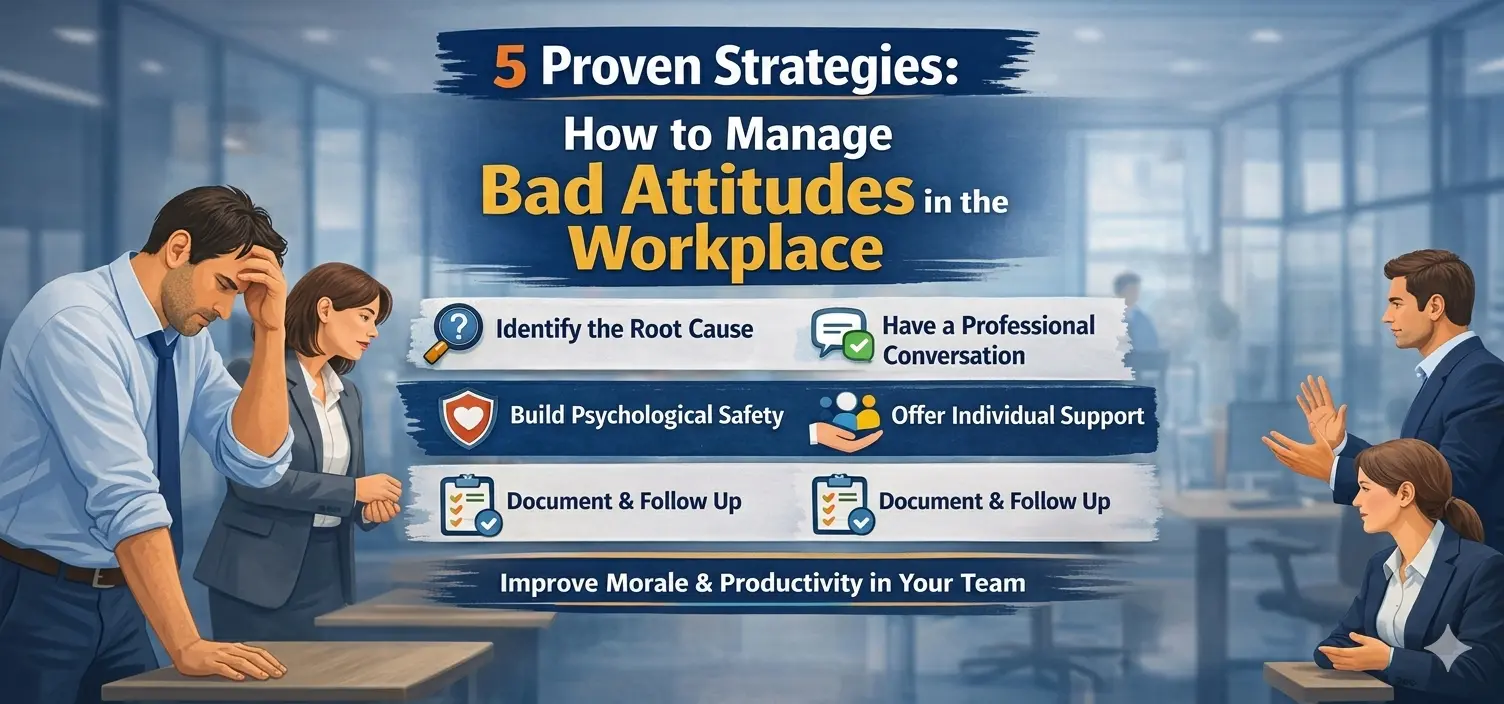
A single negative mindset in the office can quietly disrupt productivity, collaboration, and trust. Managers often underestimate how quickly one employee’s attitude can influence team morale, creating tension across departments and damaging long-term office culture.
This phenomenon is often called the “toxic ripple effect.” When negativity spreads, it gradually affects motivation, communication, and collaboration. Left unmanaged, it can turn a healthy workplace into a toxic work environment where engagement drops and performance suffers.
Understanding how to manage bad attitudes in the workplace is therefore not just an HR task—it’s a leadership skill essential for sustainable business success.
In reality, what managers call a “bad attitude” is usually a set of observable behaviors: chronic complaining, passive-aggressive behavior, insubordination, or resistance to change. These behaviours rarely appear without context. Often, they are symptoms of deeper organisational or personal pressures.
The goal is not simply correcting individuals but building a culture where people feel supported, respected, and motivated. That’s where workplace attitude management becomes critical. When leaders proactively address behaviour and support employee wellbeing, organisations see stronger collaboration, higher employee engagement, and better long-term outcomes.
Businesses that invest in structured corporate wellbeing programs often see measurable improvements in productivity, engagement, and workplace culture.
Quick Answer: How to Manage Bad Attitudes in the Workplace
If you’re searching for a practical solution, here are the five proven strategies leaders use to address negative behaviour at work:
- Identify the root cause behind the behaviour.
- Conduct a professional behavioural conversation.
- Build psychological safety within the team.
- Provide personalised support and development resources.
- Maintain documentation and accountability through structured processes.
When applied consistently, these steps transform negative behaviour into opportunities for growth and healthier workplace relationships.
Transform Your Workplace Culture Today
Healthy organisations don’t just react to negativity—they build systems that prevent it.
Transform Your Office Culture – Get Started with Spark
https://sparkyourhealth.co.uk/
Email: info@sparkyourhealth.co.uk
Phone: 0843 289 3468
Identifying the Root Cause Behind Negative Behaviour
Before reacting to poor behaviour, leaders must ask an important question: Is the issue with the person, or with the environment?
In many cases, negative workplace behaviour stems from structural problems rather than personal flaws.
Burnout and workplace pressure
Increasing workloads and unrealistic expectations frequently lead to workplace burnout. When employees feel overwhelmed or unsupported, frustration can manifest as irritability or disengagement.
Signs may include:
- Increased absenteeism
- Declining motivation
- Communication breakdowns within teams
Psychological factors behind negativity
Human psychology naturally focuses on problems more than successes. This bias often amplifies dissatisfaction when employees feel unheard or undervalued.
Without open communication channels, frustration can escalate into behaviours that harm collaboration and reduce employee retention.
External stress factors
Workplace behaviour is rarely isolated from personal life. Financial pressures, family responsibilities, or health concerns can significantly impact mood and performance.
Forward-thinking organisations address these challenges through Corporate Wellbeing Programs that support employee mental health, provide stress management tools, and promote a culture of care.
When leaders recognise the broader context behind behaviour, they can respond with empathy rather than punishment.
The Business and Productivity Impact of Negative Workplace Behaviour
Negative attitudes at work are not just interpersonal challenges—they directly affect organisational performance. When problematic behaviours go unaddressed, the consequences quickly spread across teams and departments.
Employees who frequently display negativity can reduce team morale, disrupt collaboration, and slow decision-making. Over time, this often leads to reduced output, as colleagues spend more energy managing conflict than focusing on productive work.
Unresolved negativity also contributes to higher absenteeism and disengagement. Employees working in a toxic work environment are far more likely to withdraw from team activities or reduce their level of participation.
According to Gallup research, disengaged employees cost the global economy more than $8.8 trillion in lost productivity each year. For leaders, learning how to manage bad attitudes in the workplace is therefore not simply about discipline—it is about protecting long-term performance and building a healthier, more resilient workplace culture.
How to Manage Bad Attitudes in the Workplace Effectively
Managing workplace negativity requires a structured and empathetic leadership approach. The following five strategies help managers address behavioural challenges while maintaining a supportive and productive workplace culture.
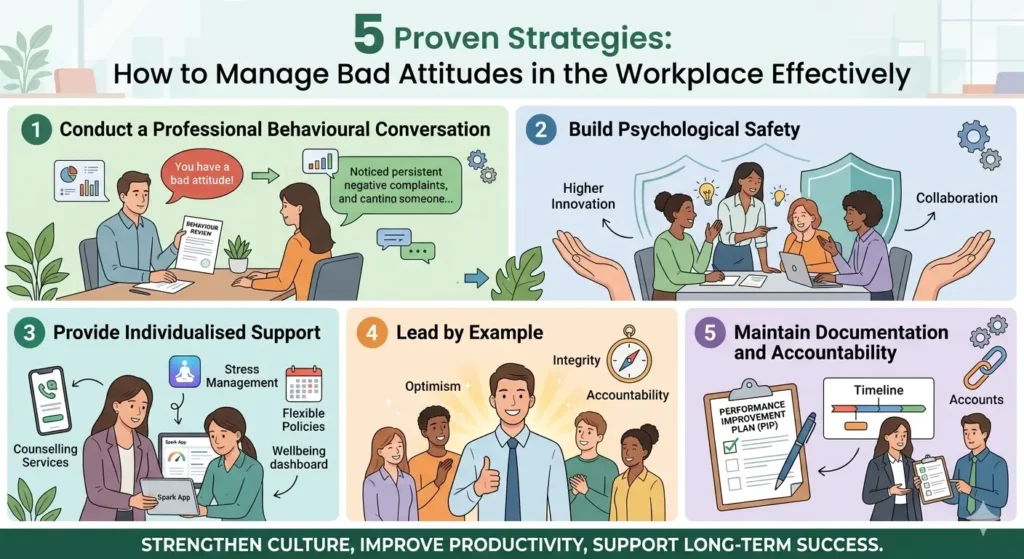
Strategy 1: Conduct a Professional Behavioural Conversation
Addressing behaviour early prevents escalation. However, successful conversations require preparation and emotional intelligence.
Managers should focus on specific actions rather than personal judgments.
Instead of saying:
“Your attitude is negative.”
Try a data-driven approach:
“I’ve noticed increased chronic complaining during team meetings and delayed responses to project updates.”
This shift reduces defensiveness and keeps the discussion productive.
How to structure the conversation
Effective leaders approach these discussions with clarity and fairness.
Key steps include:
- Prepare documented examples of behaviour.
- Use calm and neutral language.
- Focus on outcomes and team impact.
- Agree on measurable improvements.
Managers who practice strong emotional intelligence often achieve better results because they balance accountability with empathy.
When employees understand expectations clearly, they are more likely to adjust their behaviour positively.
Strategy 2: Build Psychological Safety Within the Team
Employees rarely express negativity when they feel safe, heard, and respected.
When people fear criticism or punishment, frustration builds silently. Over time, that frustration may emerge as passive-aggressive behavior or disengagement.
Creating psychological safety allows employees to speak openly about challenges before problems escalate.
Why psychological safety matters
Research consistently shows that teams with high psychological safety demonstrate:
- Higher innovation
- Stronger collaboration
- Improved employee engagement
Employees who feel safe sharing ideas are also less likely to withdraw into behaviours associated with quiet quitting.
Leadership behaviours that foster trust
Managers can strengthen psychological safety by:
- Encouraging open feedback
- Listening actively during meetings
- Responding constructively to criticism
- Supporting team members during challenges
When employees feel valued, they are far more likely to remain motivated and productive.
Improve Workplace Wellbeing with Smart Tools
Download the Spark App for Android
Digital wellbeing tools allow organisations to monitor workplace mood, track engagement trends, and support employees before challenges escalate.
Strategy 3: Provide Individualised Support and Resources
Punishing behaviour without understanding the underlying problem rarely creates lasting change.
High-performing organisations focus on development rather than discipline.
Personalised support improves outcomes
Employees facing high stress levels may benefit from structured wellbeing support such as:
- Access to counselling services
- Guided stress management techniques
- Flexible working policies
- Digital mental health tools
These initiatives strengthen resilience and reduce negativity across teams.
The role of wellbeing technology
Modern organisations increasingly use workplace wellness platforms to monitor trends and support employees proactively.
For example, wellbeing apps can offer:
- Mood tracking and emotional check-ins
- Guided meditation sessions
- Educational content on employee mental health
These resources empower employees to manage stress before it disrupts performance or collaboration.
Strategy 4: Lead by Example
Leadership behaviour directly shapes organisational culture.
Psychologists refer to this as emotional contagion—the tendency for people to mirror the emotional state of those around them.
If leaders demonstrate frustration or negativity, the team often follows.
Conversely, leaders who model optimism, accountability, and transparency inspire stronger team performance.
Practical leadership habits
Effective managers cultivate positive environments by:
- Communicating openly during challenges
- Recognising employee contributions
- Demonstrating resilience during pressure
When leaders consistently reinforce positive behaviour, negative patterns become less likely to develop.
Strategy 5: Maintain Documentation and Accountability
While empathy is essential, consistent accountability ensures fairness across teams.
Managers must distinguish between temporary struggles and repeated behavioural patterns.
When formal processes become necessary
Persistent issues such as insubordination or ongoing conflict may require structured intervention.
This is where a Performance Improvement Plan (PIP) becomes valuable.
A PIP provides:
- Clear performance expectations
- Defined timelines for improvement
- Documented support and feedback
- Transparent accountability measures
When implemented correctly, these plans encourage improvement while protecting organisational standards.
How to Handle Common Negative Attitudes at Work
Not all workplace negativity looks the same. Managers often encounter specific behavioural patterns that require slightly different responses.
Constant Complaining
When an employee repeatedly focuses on problems without suggesting solutions, it can drain energy from the entire team.
Managers should redirect conversations toward constructive thinking by asking:
- “What solution would you suggest?”
- “How can we improve this process together?”
This approach encourages accountability and shifts the conversation toward problem-solving rather than negativity.
Defensiveness Toward Feedback
Some employees react negatively when receiving feedback, interpreting it as criticism rather than support.
Leaders can reduce defensiveness by:
- focusing on shared goals
- explaining how improvements support team success
- using collaborative language such as “let’s improve this together.”
Negativity During Meetings
Public negativity can disrupt collaboration and reduce participation from other team members.
Managers should calmly acknowledge the concern and suggest discussing the issue privately after the meeting. This protects team dynamics while still addressing the employee’s perspective.
A Simple Leadership Framework for Workplace Attitude Management
Managers can follow a structured approach when addressing behavioural challenges.
- Observe – Identify specific behaviours affecting team performance.
- Understand – Investigate possible causes such as workload pressure or communication issues.
- Discuss – Hold a constructive one-to-one conversation.
- Support – Provide tools or wellbeing resources when needed.
- Review – Monitor progress and adjust expectations.
This framework ensures consistent and fair responses across the organisation.
The Future of Workplace Attitude Management
Forward-thinking organisations are shifting from reactive management to proactive prevention.
Rather than waiting for issues to appear, they invest in wellbeing strategies that strengthen resilience across teams.
These initiatives may include:
- Leadership training in emotional intelligence
- Regular wellbeing assessments
- Structured conflict resolution frameworks
- Digital tools that monitor engagement and morale
This proactive approach transforms culture from the inside out.
Conclusion
Learning how to manage bad attitudes in the workplace is one of the most valuable leadership skills in today’s business environment.
Rather than reacting with discipline alone, effective leaders address behaviour through empathy, structure, and wellbeing support.
The five strategies outlined in this guide provide a clear framework:
- Identify root causes behind negative behaviour
- Conduct professional behavioural conversations
- Build psychological safety within teams
- Provide personalised wellbeing resources
- Maintain consistent documentation and accountability
When organisations implement these practices, they strengthen culture, improve productivity, and support long-term success.
Ultimately, a positive workplace isn’t the absence of problems—it’s the presence of tools that help people solve them together.
FAQs
What causes negative attitudes in the workplace?
Negative behaviour often results from workplace stress, poor communication, burnout, or lack of recognition. External pressures such as financial concerns or personal challenges can also influence employee behaviour.
How should managers address negative behaviour at work?
Managers should address behaviour early through calm, professional conversations focused on specific actions rather than personal criticism. Providing support and clear expectations improves outcomes.
Can workplace wellbeing programs reduce negative attitudes?
Yes. Structured wellbeing initiatives improve employee engagement, support mental health, and create environments where employees feel valued and motivated.
When should HR intervene in workplace behaviour issues?
HR involvement becomes necessary when behavioural issues persist despite coaching, particularly in cases involving insubordination, repeated conflict, or performance decline.
Start Building a Healthier Workplace Today
Forward-thinking organisations recognise that employee wellbeing drives performance.
If your business wants to create a healthier culture, improve engagement, and reduce workplace negativity, the right wellbeing strategy can make all the difference.
| Explore Corporate Wellbeing Solutions https://sparkyourhealth.co.uk/corporate-solution/Or contact the team directly:📧 info@sparkyourhealth.co.uk 📞 0843 289 3468 |
Investing in wellbeing today creates stronger teams, better productivity, and a more positive workplace tomorrow.