
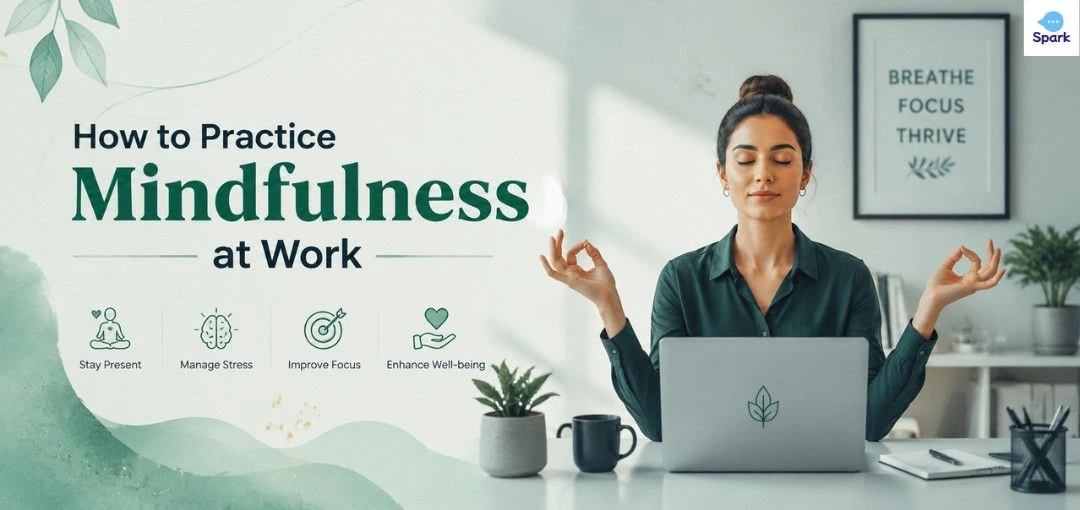
9 Simple Techniques for a Calmer Workday
Work can move quickly. Emails arrive while you are in meetings. Notifications interrupt focused tasks. Lunch gets pushed back. By the end of the day, you may feel mentally busy even after you have closed your laptop.
Learning how to practice mindfulness at work does not mean meditating for 30 minutes at your desk or trying to stay calm all day. It is about creating small moments of awareness during the workday so you can notice what is happening, refocus your attention and respond more deliberately.
This matters in UK workplaces. According to the Health and Safety Executive (HSE) , work-related stress, depression or anxiety accounted for an estimated 22.1 million working days lost in Great Britain in 2024/25.
Quick Answer: How Do You Practice Mindfulness at Work?
You can practise mindfulness at work by building short pauses into tasks you already do. Take one slow breath before opening email, focus on one task at a time, notice tension in your body, listen fully during meetings and take short device-free breaks. The goal is not perfect calm. It is repeatedly bringing your attention back to the present moment.
In This Guide
- What mindfulness at work means
- 9 simple mindfulness techniques
- A simple mindfulness routine for your workday
- Potential benefits of mindfulness at work
- What mindfulness cannot fix
- How employers can support mindfulness
- Frequently asked questions
What Is Mindfulness at Work?
Mindfulness means deliberately paying attention to what is happening in the present moment rather than operating entirely on autopilot. The NHS describes mindfulness as paying more attention to the present instead of becoming overly caught up in the past or future.
At work, this can be very practical. Mindfulness might mean noticing that your shoulders have tightened during a difficult email, recognising that your attention has wandered during a meeting or taking one deliberate breath before responding to something stressful.
You do not need special equipment, a quiet room or a long meditation session. Many useful workplace mindfulness exercises take less than two minutes.
How to Practice Mindfulness at Work: 9 Simple Techniques
These techniques are designed to fit into a normal workday. Start with one or two rather than trying to change everything at once.
1. Take One Mindful Breath Before Opening Your Email
Email often sets the pace of the day before you have consciously decided what deserves your attention. Before opening your inbox, pause for one slow breath.
- Place both feet on the floor.
- Relax your shoulders.
- Take one comfortable breath in and out.
- Then open your inbox.
The purpose is not to make stress disappear. It simply creates a brief gap between arriving at work and reacting to the first demand.
2. Single-Task Instead of Constantly Switching
Mindfulness becomes difficult when your attention is divided between messages, tabs, meetings and notifications. Choose one task and give it your full attention for a defined period.
- Choose one clearly defined task.
- Close anything you do not need for that task.
- Silence non-essential notifications.
- Work for 25 to 50 minutes.
- When your attention wanders, notice it and gently return to the task.
That final step is important. Mindfulness is not about never becoming distracted. It is about noticing distraction and returning your attention without unnecessary frustration.
3. Use a 60-Second Breathing Reset
When you feel rushed or mentally scattered, a short breathing pause can help you slow down and reconnect with what you are experiencing.
Try this:
- Breathe in slowly and comfortably.
- Notice the sensation of the breath entering your body.
- Breathe out without forcing it.
- Repeat for around one minute.
You do not need to change your breathing dramatically. Simply paying attention to it can act as an anchor to the present moment. This approach is consistent with mindfulness breathing guidance provided by Guy’s and St Thomas’ NHS Foundation Trust .
4. Do a Quick Body Scan Between Tasks
Stress often shows up physically before we consciously notice how tense we feel. A short body scan can help you identify tension without needing to leave your desk.
Pause for around 60 seconds and notice:
- your forehead and jaw;
- your neck and shoulders;
- your hands and grip;
- your breathing;
- how your feet feel against the floor.
If you notice tension, relax the area where possible. There is no need to force yourself to feel different. The practice is simply noticing what is already there.
For a combination of mindfulness and simple movement, see our wellbeing exercises guide .
5. Practise Mindful Listening in Meetings
Many meetings become mentally exhausting because people are listening while also checking messages, preparing their response or thinking about the next task.
During your next conversation, try giving the speaker your full attention for one minute.
- Put your phone away.
- Avoid checking notifications.
- Listen without planning your reply immediately.
- Notice when your mind wanders and bring it back to the conversation.
This can make meetings feel less fragmented and may also improve the quality of communication.
6. Take a Device-Free Break
A break does not always feel like a break when it simply replaces a work screen with a social-media screen. Try creating at least one short period during the day without digital input.
This could mean:
- eating part of your lunch without your phone;
- taking a five-minute walk without headphones;
- making tea without checking messages;
- sitting near a window for a few minutes.
During the break, notice what you can see, hear and physically feel rather than trying to fill every moment with content.
7. Pause Before Replying to a Stressful Message
One of the most useful forms of mindfulness at work happens immediately before you react.
When an email, Slack message or conversation triggers a strong response:
- Stop typing.
- Take one slow breath.
- Notice what you are feeling.
- Ask yourself what response would be useful rather than simply immediate.
- Reply when you feel able to do so clearly.
A pause of even a few seconds can help you separate the situation itself from your first automatic reaction.
8. Use Task Transitions as Mindfulness Triggers
You do not need to remember to “be mindful” randomly throughout the day. It is easier to attach mindfulness to moments that already happen.
Good triggers include:
- before joining a meeting;
- after finishing a call;
- before opening your inbox;
- after completing a major task;
- when returning from lunch.
At each transition, stop for one breath and ask: What am I doing next, and where is my attention right now?
9. End the Workday With a Mindful Shutdown
For hybrid and remote workers especially, work can continue mentally long after the laptop is closed. A short shutdown routine can help create a clearer boundary.
In the final few minutes of your workday:
- write down unfinished tasks;
- choose the first priority for tomorrow;
- close unnecessary browser tabs;
- switch off work notifications where appropriate;
- take one breath before physically leaving your workspace.
This does not guarantee that you will stop thinking about work, but it creates a deliberate end point rather than allowing the working day to fade indefinitely into the evening.
A Simple Mindfulness Routine for a Typical Workday
You do not need to use every technique above. A realistic workplace mindfulness routine could look like this:
| Work situation | Mindfulness technique | Time needed |
|---|---|---|
| Starting work | One mindful breath before email | 10–20 seconds |
| Focused task | Single-task with notifications reduced | 25–50 minutes |
| Before a meeting | Feet on floor + one slow breath | 30 seconds |
| Between tasks | Quick body scan | 60 seconds |
| Feeling overwhelmed | Breathing or sensory grounding | 1–2 minutes |
| Lunch or afternoon break | Short device-free walk or pause | 5–10 minutes |
| End of workday | Mindful shutdown routine | 2–5 minutes |
The best routine is not the most complicated one. Choose the practices that fit naturally into your day and repeat them consistently.
A Quick Grounding Exercise for Stressful Moments
If your thoughts are racing before a difficult meeting or conversation, you can also use the 5-4-3-2-1 grounding technique.
Notice:
- 5 things you can see;
- 4 things you can physically feel;
- 3 things you can hear;
- 2 things you can smell;
- 1 thing you can taste.
The purpose is to redirect attention towards your immediate surroundings. If grounding exercises make you feel uncomfortable or are not helpful for you, stop and use a different technique.
What Are the Potential Benefits of Mindfulness at Work?
Workplace mindfulness has been studied as one approach to supporting stress management and wellbeing. Research has reported benefits in areas such as perceived stress, resilience and wellbeing for some participants, although the evidence is not strong enough to suggest mindfulness will work equally well for everyone or solve structural workplace problems on its own.
A UK public-health evidence review found some positive findings from workplace mindfulness programmes while also highlighting limitations in the quality and consistency of the evidence. You can read the UK workplace mental health evidence review for further context.
In everyday working life, mindfulness may help some people:
- notice stress earlier;
- pause before reacting automatically;
- return attention to the task at hand;
- become more aware of physical tension;
- listen more attentively during conversations;
- create clearer transitions between work and home.
These are potential benefits rather than guaranteed outcomes. Mindfulness should be treated as one practical tool within a broader approach to wellbeing.
Mindfulness Helps — But It Cannot Fix an Unhealthy Workplace
Mindfulness is sometimes presented as though employees simply need to become better at coping with pressure. That is too simplistic.
A breathing exercise cannot compensate for an unmanageable workload. A meditation app cannot correct poor management. A mindful lunch break will not solve repeated after-hours demands.
Employers still need to address workplace factors such as:
- excessive or unclear workloads;
- lack of management support;
- poor communication;
- unrealistic deadlines;
- bullying or conflict;
- limited control over how work is carried out;
- unclear roles and responsibilities.
The HSE makes clear that employers have responsibilities for assessing and managing work-related stress risks. Mindfulness can complement that work, but it should not replace it.
For wider guidance on supporting employees, see our employee mental health resources for UK employers .
How Can Employers Support Mindfulness at Work?
Employers do not need to turn mindfulness into another compulsory wellbeing initiative. In many cases, the most useful support is creating working conditions where short pauses and healthy boundaries are genuinely possible.
Make Short Breaks Normal
Employees are less likely to take useful breaks if they believe stepping away from their screen will be judged negatively. Managers can help by modelling reasonable breaks themselves.
Protect Focus Time
Avoid creating a culture where every notification requires an immediate response. Teams can agree when real-time communication is necessary and when focused work should be protected.
Respect After-Hours Boundaries
Where possible, avoid creating an expectation that employees remain available in the evening. Scheduled email delivery and clear communication norms can help.
Keep Participation Voluntary
Mindfulness will not suit everyone. Employees should not feel pressured to meditate, disclose personal information or participate in activities that make them uncomfortable.
Connect Mindfulness With Wider Support
Mindfulness should sit alongside appropriate workplace support, which may include manager guidance, Employee Assistance Programmes, occupational health and professional mental health services where needed.
For HR and People Teams: Make Everyday Wellbeing Easier to Access
Spark Your Health helps organisations give employees practical wellbeing tools while providing employers with anonymised insight and structured resources across mental, physical, social and financial wellbeing.
Explore our corporate wellness programmes for UK employers or review our employee wellbeing platform checklist if you are comparing workplace wellbeing options.
Book a 15-minute employer demo
Frequently Asked Questions About Mindfulness at Work
What is the easiest way to practise mindfulness at work?
Start with one existing work trigger. For example, take one slow breath before opening email or before joining a meeting. Linking mindfulness to something you already do makes the habit easier to remember than trying to schedule a separate meditation session.
Can you practise mindfulness while working?
Yes. Workplace mindfulness does not always require stopping work. You can practise by focusing fully on one task, noticing when your attention wanders, listening carefully in meetings or becoming aware of tension while sitting at your desk.
How long should workplace mindfulness take?
It can be very short. Some useful practices take 30–60 seconds, while a device-free break or mindful walk may last five or ten minutes. Consistency is usually more realistic than trying to fit long sessions into a busy workday.
What mindfulness exercises can I do at my desk?
Simple desk-based exercises include mindful breathing, a 60-second body scan, sensory grounding, noticing your posture and practising single-tasking. None of these requires special equipment.
Can mindfulness help with work stress?
Mindfulness may help some people notice stress reactions earlier, create a pause before responding and bring attention back to the present moment. However, it is not a substitute for addressing workplace causes of stress such as excessive workload, poor management or unsafe working conditions.
How can employers encourage mindfulness without making it feel forced?
Keep participation optional and focus on creating conditions that support wellbeing. Encourage sensible breaks, protect focus time, respect after-hours boundaries and provide access to different forms of support rather than assuming mindfulness will suit every employee.
Final Thoughts: Mindfulness at Work Starts With Small Moments
Learning how to practice mindfulness at work does not require changing your personality or creating a perfect morning routine.
Start smaller.
Take one breath before opening your inbox. Give one task your full attention. Notice tension before it builds. Put your phone away during one conversation. Create a clear end to your working day.
Mindfulness is the repeated act of noticing where your attention is and choosing where to place it next. Even during a busy workday, there are opportunities to practise that skill.
And if work itself is creating sustained stress, remember that individual mindfulness should not carry the full burden. Healthy workplaces also need realistic workloads, supportive management, clear boundaries and appropriate routes to professional support.
Updated: August 2026
Prepared by: Spark Your Health Editorial Team
This article provides general wellbeing information and is not medical advice. If stress, anxiety or other mental health concerns are significantly affecting your daily life, consider speaking with an appropriate healthcare professional.
The modern UK workplace has a stress problem and it is getting worse. According to the Health and Safety Executive, 17.1 million working days were lost in 2022/23 due to stress, anxiety, and depression. Behind that statistic are real people: the project manager who cannot switch off at 10pm, the team leader eating lunch at their desk for the fourth day running, the HR director watching absence rates quietly climb.
Learning how to practice mindfulness at work is one of the most evidence-backed responses to this crisis. And the great news? It does not require a yoga retreat, a mindfulness app subscription, or a 30-minute morning ritual. Real, sustainable mindfulness is built in seconds — woven into the fabric of an ordinary workday.
Practising mindfulness at work reduces stress and improves focus by incorporating short, device-free breaks, single-tasking instead of multitasking, and brief breathing exercises performed directly at your desk.
Whether you are an individual professional looking to reclaim your mental clarity, or an HR leader building a culture that actually sustains performance — this guide is built for you.
📞 Want to speak to a workplace wellbeing expert today?
Call Spark Your Health:
or email info{@}sparkyourhealth.co.uk
This article was produced by the editorial team at Spark Your Health — UK specialists in evidence-based corporate wellbeing. Spark partners with organisations across the UK to build healthier, more resilient workforces through prevention-first wellness strategy. To learn more, visit sparkyourhealth.co.uk or call 0843 289 3468.