
Workplace stress is costing UK businesses an estimated £28 billion per year through absenteeism, presenteeism, and rising staff turnover. And yet, most companies are still treating symptoms rather than causes — free fruit bowls, the occasional pizza Friday, and a generic wellbeing email once a quarter.
The truth is, your people are burning out. Quietly. Systematically. And often invisibly, right up until the moment they hand in their notice.
A professionally planned wellness retreat changes that. Not because it takes staff to a nice hotel for a night — but because it creates a protected space for real recovery, genuine human reconnection, and the kind of cultural reset that no perks package can manufacture.
This guide gives you a practical, expert-backed blueprint to plan a health resort that actually works — before, during, and long after the event ends.
📞 Ready to get started now?
Contact the Spark Your Health team today
What a Wellness Retreat Actually Is — And What It Isn’t
There’s a persistent myth that a corporate wellness trip means a team-building day with trust falls and enforced socialising. For introverts, high-achievers, and already-exhausted employees, that approach doesn’t restore energy — it drains what little is left.
A genuine workplace mental health retreat is structured around recovery, not performance. It’s designed to decompress, not impress. The agenda is intentional. The environment is calming. The activities are restorative rather than competitive. And critically, it’s aligned to real organisational goals — not just a day off with a corporate badge on it.
When done right, the difference is felt immediately. Employees return not just refreshed but re-engaged, with renewed trust in leadership and a measurable lift in psychological safety across teams.
The Core Benefits of a Company Wellness Retreat
It Addresses Root Causes, Not Just Symptoms
Reactive perks treat the surface. A well-planned company wellness health resort goes deeper, it gives HR leaders and senior managers a structured opportunity to observe team dynamics, notice where friction lives, and understand what’s driving disengagement at a cultural level.
Before any retreat, identifying structural stressors early through formal signs of burnout at work is critical before organising group events. Without that diagnostic step, you risk planning a retreat around the wrong problems — and missing the people who need support most.
It Signals That People Are the Priority
In a post-pandemic UK workforce, employees are not just looking for a salary. They want to feel valued, seen, and protected from chronic overload. A thoughtfully planned executive wellness retreat or staff away-day sends a clear, credible message: this organisation invests in its people, not just its profits.
That signal directly impacts retention. Research from Deloitte found that 77% of employees have experienced burnout in their current role — and those who feel unsupported are three times more likely to leave within the year.
It Delivers Measurable Corporate Retreat ROI
The business case for preventing employee burnout through retreats is compelling. Lower absenteeism, improved team cohesion, reduced recruitment costs, and stronger performance metrics all follow from a workforce that feels psychologically safe and physically well.
Organisations that commit to Corporate Wellbeing Programs report significant improvements in engagement scores and team productivity within 90 days of a structured intervention — whether that begins with a retreat, a workshop, or a full digital programme rollout.
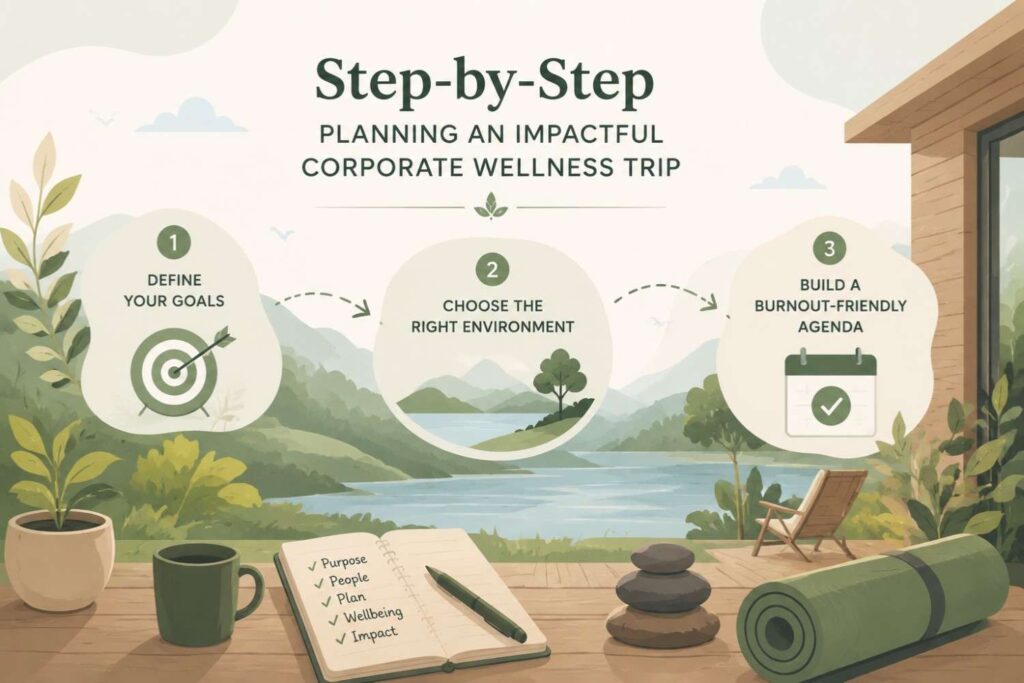
Step-by-Step: Planning an Impactful Corporate Wellness Trip
1. Define Your Strategic Goals First
Before you book a venue or build an agenda, get clear on why you’re running this retreat. Are you targeting physical decompression after a high-pressure quarter? Mental health recovery following a period of rapid growth or restructuring? Cross-department bonding after remote-first working fragmented your culture?
Your goals determine everything: the duration, the location, the facilitation style, the activities, and the follow-up strategy. Vague goals produce vague results. Sharp goals produce measurable outcomes.
Common objectives for a corporate wellness workshop include: reducing self-reported stress scores by a target percentage, improving eNPS (employee net promoter score), rebuilding trust after leadership changes, or upskilling managers in stress management for teams.
2. Select the Right Environment
The venue is not a luxury decision — it’s a therapeutic one. Noisy city-centre hotels with conference rooms and buzzing bars actively undermine the purpose of a restorative retreat.
For a wellness retreat UK setting, prioritise quiet, nature-adjacent locations: countryside estates, coastal retreats, or woodland lodges where employees can genuinely disconnect. Low sensory overload is the goal. Natural light, open space, and distance from notifications matter more than five-star branding.
Consider accessibility, too. Not every team member will be comfortable with rural isolation or physical activity. Build in options. Inclusion is part of wellbeing.
3. Build a Burnout-Friendly Agenda
This is where most corporate retreat planning falls short. A typical corporate agenda is still packed with presentations, workshops, and structured sessions from 8am to 8pm — which is simply exhaustion with a different label.
A genuinely burnout-friendly agenda limits structured content to no more than 60% of the day. The rest is intentionally unscheduled: time for walks, reflection, creative activities, and quiet. Incorporating structured wellbeing activities at work such as mindfulness sessions and group movement breaks gives participants the experience of proactive self-care — not just talking about it.
Corporate Fitness Retreat Ideas That Work
The most effective company team-building retreats in 2026 combine evidence-based wellbeing practice with genuine human connection. Here are the formats that consistently deliver the strongest results.
Sleep & Recovery Workshops:
Chronic sleep deprivation is one of the leading drivers of cognitive burnout. A facilitated session on healthy sleep mechanics — covering circadian rhythm, screen exposure, and recovery habits — gives employees practical tools they’ll use for months after the retreat.
Nutrition for Mental Performance:
A half-day nutrition workshop reframes how employees understand energy management. This isn’t about dieting — it’s about building a healthy workplace culture where staff understand the relationship between food, focus, and fatigue.
Boundaries & Workload Mapping:
One of the most powerful sessions you can run is one where employees are guided to map their actual workload and identify where they consistently exceed healthy limits. Giving staff the time to develop a personalised wellness action plan helps protect mental health long after returning to the office.
Nature-Based Decompression:
Forest bathing, guided outdoor walks, or simply unstructured time in a natural setting have been clinically shown to reduce cortisol levels. This doesn’t require elaborate facilitation — it requires space and permission.
Digital Detox Blocks:
Scheduled screen-free periods during the retreat teach employees that disconnection is productive. Many report this as the single most impactful element of the entire experience.
The Hybrid Approach: Turning a 3-Day Retreat Into a Year-Round Strategy
Here is the honest reality of any corporate retreat: the well-being wears off. Within two to three weeks of returning, most employees are back in the same inbox, the same meetings, and the same patterns that caused burnout in the first place. This is the post-retreat slump — and failing to plan for it is the most common mistake organisations make.
The solution is no longer retreats. It’s building an ecosystem that sustains the progress made during the retreat through daily digital touchpoints, manager accountability check-ins, and proactive monitoring.
An employee wellness program that combines physical events with digital wellbeing tools creates a continuous loop of support rather than a one-off intervention. Combining physical events with a digital framework allows businesses to maximize ROI with workplace wellness programs through sustained behavioural tracking — giving HR teams anonymised mood analytics and pulse metrics that flag early warning signs before they escalate into crisis.
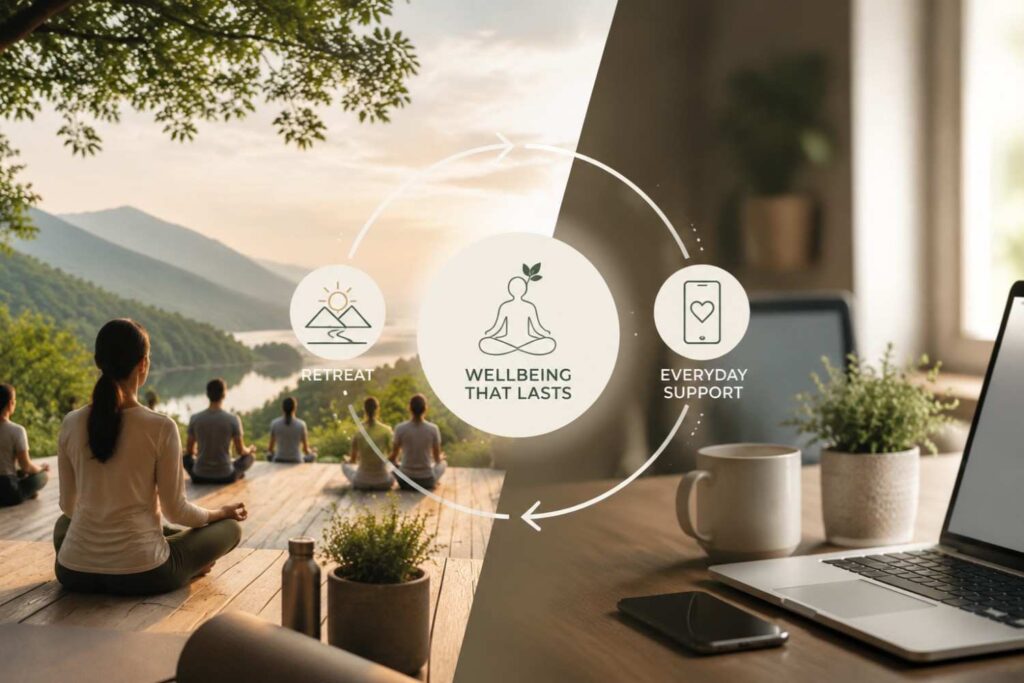
This hybrid model is what separates a corporate health day from a long-term digital wellbeing solution strategy. The retreat is the ignition. The platform is the fuel.
Staff Wellness Days vs. Full Retreats: Which Does Your Organisation Need?
Not every business has the budget or logistical capacity for a multi-day retreat. Staff wellness days are a valuable and cost-effective alternative — particularly for organisations in early stages of building a wellbeing culture.
A single, well-structured corporate health day can introduce mindfulness, physical movement, and open conversation around mental health in a way that shifts perception and builds trust. It won’t replace the depth of a full retreat, but it creates the foundation for one.
Boosting employee morale doesn’t always require a large budget — it requires genuine intention, skilled facilitation, and a clear signal from leadership that wellbeing is taken seriously.
Conclusion: The Retreat Is the Starting Point, Not the Solution
A brilliantly planned wellness retreat is one of the most powerful investments a UK business can make in its people. It resets culture, rebuilds trust, and gives employees the lived experience of being genuinely valued — not just managed.
But the retreat alone is not enough. The organisations that see lasting reductions in burnout, genuine improvements in retention, and measurable gains in team performance are those that treat the retreat as the beginning of a wider commitment to employee health — not a once-a-year gesture.
The most effective corporate wellness strategy combines the depth of a face-to-face retreat with the consistency of a year-round employee wellness program that tracks, supports, and adapts to your people in real time.
Frequently Asked Questions
How long should a corporate wellness retreat be?
For meaningful impact, two to three days is the sweet spot. One day rarely allows enough time for genuine decompression. Four or more days can feel excessive for most teams. A 2-night retreat with a structured but flexible agenda typically delivers the strongest results.
What is the average cost of a wellness retreat UK for companies?
Costs vary significantly based on group size, venue, and facilitation. A professionally facilitated wellness retreat for a team of 20–30 people in the UK typically ranges from £3,500 to £15,000+. However, when measured against the cost of replacing a single experienced employee (estimated at 50–200% of annual salary), the ROI case is strong.
Do wellness retreats actually reduce burnout?
Yes — when they are part of a broader strategy. Standalone retreats produce short-term improvements in self-reported wellbeing and team cohesion. When combined with an ongoing employee wellness program and digital monitoring tools, the sustained impact on burnout rates is statistically significant.
What should a corporate wellness retreat agenda include?
A high-impact agenda should include restorative nature-based activities, facilitated mental health conversations, sleep and nutrition education, workload boundary-setting workshops, and adequate unstructured time. Avoid over-scheduling. Recovery requires space.
Can small businesses run a fitness retreat?
Absolutely. Staff wellness days and smaller retreats are fully scalable. A team of eight benefits from a structured wellbeing day just as much as an enterprise team of 300 — the format simply adapts to size and budget.
How do I measure the ROI of a health resort?
Track eNPS scores before and after, monitor absenteeism rates over the following quarter, and use pulse survey data to measure changes in self-reported stress and engagement. Pairing a retreat with an analytics-enabled wellbeing platform makes this measurement precise and ongoing.
🌿 Ready to Plan Your Corporate Wellness Retreat?
Whether you’re exploring your first staff wellness day or designing a full retreat strategy for a team of 200, Spark Your Health has the expertise, tools, and UK-based experience to make it exceptional.
📧 Email us: info@sparkyourhealth.co.uk
🌐 Explore our full suite of Corporate Wellbeing Programs— built for UK businesses that are serious about their people.
Your team gave you their best. Give them the support they deserve.