Updated for World Mental Health Day 2026
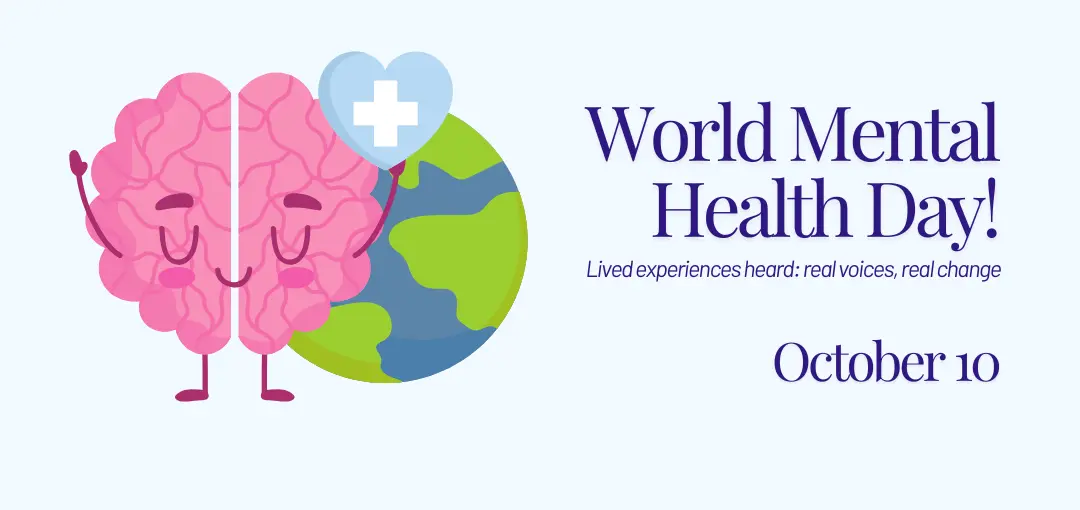
World Mental Health Day 2026 takes place on Saturday, 10 October. This year’s theme is “Lived experiences heard: real voices, real change.”
The message goes further than asking people to talk about mental health. It asks organisations, services and decision-makers to listen to people with lived experience and give them a meaningful role in shaping what happens next.
This guide explains the 2026 theme in plain English, what good mental health support can look like, how to support someone who is struggling, and how UK employers can turn World Mental Health Day into useful action rather than another one-day awareness campaign.
World Mental Health Day 2026 at a Glance
| World Mental Health Day 2026 date | Saturday, 10 October 2026 |
|---|---|
| 2026 theme | Lived experiences heard: real voices, real change |
| When is it held? | 10 October every year |
| Who established it? | World Federation for Mental Health |
| When did it begin? | 1992 |
| Overall purpose | To raise awareness of mental health and mobilise action in support of better mental health |
| 2026 focus | Making lived experience part of decisions, service design and meaningful change |
In This Guide
- When is World Mental Health Day 2026?
- What is the 2026 theme?
- What is World Mental Health Day?
- What does lived experience mean?
- Being heard versus having influence
- What does good mental health support look like?
- How can you support someone who is struggling?
- Mental health at work
- The Spark Listen → Act → Review framework
- Six workplace factors employers should listen to
- World Mental Health Day ideas for workplaces
- What employers should avoid
- Moving from awareness to year-round support
- World Mental Health Day FAQs
When Is World Mental Health Day 2026?
World Mental Health Day 2026 is Saturday, 10 October.
World Mental Health Day takes place on 10 October every year, so unlike some awareness events, the date does not change annually.
People, communities, healthcare services, charities and employers around the world use the day to talk about mental health, challenge stigma and consider what practical action could improve people’s wellbeing and access to support.
What Is the World Mental Health Day 2026 Theme?
The official World Mental Health Day 2026 theme is:
“Lived experiences heard: real voices, real change.”
The theme focuses on the knowledge held by people who have personally experienced mental health conditions, sought support, used mental health services, cared for someone, or faced barriers when trying to get help.
The World Health Organization’s 2026 campaign makes an important distinction: being invited to tell your story is not the same as being involved in decisions.
Meaningful involvement means giving people opportunities to help identify problems, influence policy, co-design services and assess whether support is actually working.
You can read the official WHO World Mental Health Day 2026 campaign information .
What Is World Mental Health Day?
World Mental Health Day is a global awareness event held every 10 October. Its purpose is to raise awareness of mental health issues and encourage action that improves mental health support, understanding and care.
The World Federation for Mental Health first observed World Mental Health Day on 10 October 1992. It has since grown into an international event supported by organisations including the World Health Organization.
Why is World Mental Health Day celebrated?
Awareness still matters because stigma, misunderstanding and difficulty accessing support remain real problems.
But awareness is most useful when it leads somewhere. A workplace poster, social post or annual wellbeing email has limited value if people still do not know how to ask for support or believe nothing will change if they raise a concern.
Is World Mental Health Day recognised in the UK?
Yes. UK employers, NHS organisations, charities, schools, community groups and individuals mark World Mental Health Day each October.
For employers, it can be a useful point to review what support already exists, what employees actually use and whether working conditions themselves are contributing to avoidable pressure.
What Does “Lived Experience” Mean in Mental Health?
Lived experience means knowledge gained through personally experiencing something.
In mental health, this can include personally experiencing a mental health condition, seeking or receiving support, struggling to access appropriate care, recovering, living with an ongoing condition, or supporting someone as a family member or carer.
Professional knowledge, clinical research and lived experience are different forms of knowledge. One does not need to replace another.
People who have used a system often notice things that are difficult to see from the outside:
- support that is technically available but difficult to access;
- language that unintentionally feels judgemental;
- processes that discourage people from asking for help;
- workplace policies that look supportive on paper but are difficult to use;
- services that solve the wrong problem; or
- small practical changes that could make support more useful.
One person’s experience is not everyone’s experience
This is an important part of using lived experience responsibly.
No individual can represent everybody with anxiety, depression, ADHD, bipolar disorder, trauma, a particular disability or any other mental health experience.
Good involvement therefore means listening to a range of people rather than selecting one story and treating it as universal.
Being Heard Is Not the Same as Having Influence
The 2026 theme becomes much more useful when we distinguish between listening and meaningful involvement.
| Listening onlyMeaningful involvement | |
|---|---|
| “Tell us about your experience.” | “Help us understand what needs to change.” |
| Running an employee survey | Sharing what was learned and what action will follow |
| Inviting one employee to tell a personal story | Including different employee perspectives when designing support |
| Launching a wellbeing initiative for employees | Designing wellbeing support with employees |
| Collecting feedback once | Reviewing whether changes actually helped |
This does not mean every employee needs to sit on a wellbeing committee. It means organisations should create sensible ways for the people affected by a decision to influence it.
Most importantly, nobody should feel pressured to disclose a diagnosis or private mental health experience in order to contribute.
Why World Mental Health Day Still Matters
Mental health awareness has increased considerably, but knowing the right terminology is not the same as having access to good support.
People may understand that mental health matters and still worry about being judged at work. An organisation may have an Employee Assistance Programme while employees do not know how to access it. Managers may genuinely want to help but feel uncertain about what they should say.
World Mental Health Day is therefore most useful when it prompts a practical question:
What could we make easier, safer or more useful after 10 October than it was before?
That applies to individuals, families, healthcare systems and workplaces alike.
What Does Good Mental Health Support Actually Look Like?
Good mental health support is not one single service. Different people need different things at different times.
Useful support usually has several qualities in common.
It is easy to understand
People should know what support is available, what it is for and how to access it without navigating a complicated process.
It respects privacy
Employees are less likely to use support if they do not understand what is confidential or worry that personal information will affect how they are treated at work.
It starts before a crisis
People should not have to wait until they are unable to work before asking for help. Early conversations, practical adjustments and appropriate professional support may help prevent difficulties from escalating.
It gives people appropriate choice
One employee may want to speak to a manager. Another may prefer confidential counselling, an EAP, occupational health or their GP.
A good support pathway makes those options clear rather than assuming one service suits everyone.
It addresses the environment as well as the individual
Breathing exercises may be useful. They do not fix chronic understaffing, bullying, unrealistic deadlines or poor management.
Supporting mental health means helping individuals while also addressing avoidable pressures in the environment around them.
How Can You Support Someone Who Is Struggling With Their Mental Health?
You do not need to be a therapist to be supportive. In many situations, a calm conversation is a useful place to start.
Notice
If someone seems unusually withdrawn, tired, irritable or overwhelmed, pay attention without immediately assuming you know the reason.
Ask
Choose a suitable moment and ask an open question.
“You’ve seemed under a lot of pressure recently. How are things?”
Listen
Give the person space to answer. Try not to jump straight into advice or compare their experience with your own.
Support
Ask what might help. Depending on the situation, this could mean practical help, speaking with a manager, contacting a GP or using confidential mental health support.
Follow up
One conversation does not always resolve a difficult situation. A simple follow-up can show that your concern was genuine.
If you want more practical guidance on starting conversations, read Spark’s Time to Talk Day guide to better mental health conversations .
If Someone Needs Urgent Mental Health Help
If someone’s life is in immediate danger, call 999 or go to A&E.
In England, people who need urgent mental health help can call NHS 111 and select the mental health option.
Support arrangements differ across the UK nations. Use the appropriate NHS service where you live, or contact Samaritans free on 116 123 if you need someone to talk to.
Spark also has a detailed guide to safe conversations, urgent support and suicide prevention if you are worried about someone who may be at risk.
Mental Health at Work: What Do Employees Actually Need?
Workplace mental health is sometimes reduced to benefits: an app, a helpline, a workshop or a wellbeing day.
Those resources can be useful, but employees also experience the workplace itself. Workload, management, relationships, job clarity, autonomy and organisational change can all affect how manageable work feels.
Good workplace mental health support therefore needs both:
- support for the person; and
- attention to the conditions in which that person works.
Manageable expectations
Employees need a realistic understanding of priorities, capacity and what can wait. Continually asking people to become more resilient while workloads remain unreasonable does not address the source of the problem.
A safe way to raise concerns
People should know who they can speak to and feel that raising a concern will not automatically be treated as a performance problem.
Managers who know their role
Managers do not need to diagnose mental health conditions. They need to listen, respond respectfully, understand the support pathway and act on work-related issues within their control.
Clear support routes
EAPs, counselling, occupational health, manager support and external services serve different purposes. Employees are more likely to use them when those differences are clearly explained.
Spark’s Employee Mental Health Resources UK guide explains how these common support options fit together.
Appropriate workplace adjustments
Sometimes support involves a practical change to work rather than another wellbeing resource. Depending on the circumstances, that could mean temporarily adjusting workload, hours, communication methods, work location or how tasks are structured.
Where a mental health condition meets the Equality Act 2010 definition of disability, an employer may have a legal duty to consider reasonable adjustments.
Feedback that leads to action
Asking employees about wellbeing and then doing nothing with the information can damage trust.
Even when an organisation cannot implement every suggestion, it should explain what it heard, what it can change and what it cannot.
The Spark Listen → Act → Review Framework
The 2026 World Mental Health Day theme gives organisations a useful question: what happens after people speak?
A simple way to avoid turning employee listening into a tick-box exercise is to use three steps.
1. Listen
Understand what people are experiencing before deciding what the solution should be.
- What makes work harder than it needs to be?
- What support do employees know about?
- What stops people using it?
- Where do managers feel unsure?
- Which groups may be having a different experience?
Use more than one method where possible: anonymous feedback, team conversations, usage data, absence patterns and voluntary employee involvement can reveal different parts of the picture.
2. Act
Choose changes that respond to what you heard.
That may mean improving signposting, training managers, changing a process, reviewing workloads, tackling a recurring management issue or improving access to confidential support.
Not every action needs to be large. It needs to be relevant.
3. Review
Ask whether the change made any difference.
- Did employees understand the new support pathway?
- Did more people use appropriate resources?
- Has the original problem improved?
- What are employees saying now?
- What needs adjusting?
Then repeat the cycle.
Listening builds trust only when people can see that their voice has somewhere to go.
Six Workplace Factors Worth Listening To
For UK employers, the Health and Safety Executive provides a useful framework for understanding work-related stress.
HSE identifies six areas of work design that can contribute to stress when poorly managed: demands, control, support, relationships, role and change.
| AreaQuestions worth asking | |
|---|---|
| Demands | Are workload, deadlines and working patterns realistically manageable? |
| Control | Do employees have an appropriate level of say in how they organise their work? |
| Support | Do people receive useful information, resources and help from managers and colleagues? |
| Relationships | Are conflict, bullying and unacceptable behaviour addressed properly? |
| Role | Do employees understand what is expected of them and where responsibilities sit? |
| Change | Are organisational changes explained and managed in a way that reduces unnecessary uncertainty? |
UK employers have a legal duty to protect employees from work-related stress by assessing risks and taking appropriate action.
Spark’s workplace stress risk assessment guide provides a practical example for employers who want to review these risks more systematically.
What Are You Dealing With Right Now?
Mental health is a broad subject. If you arrived here because something specific is affecting you or your team, choose the route that best matches the situation.
Stress is showing up physically
Headaches, muscle tension, fatigue, digestive changes and sleep problems can occur during periods of stress, although physical symptoms can also have other causes.
Read: Physical Signs of Stress
Work is leaving you persistently exhausted
Learn how ongoing occupational stress can differ from an ordinary difficult week and what signs may suggest burnout deserves attention.
Read: Signs of Burnout at Work
Stress is interfering with sleep
Explore the relationship between sleep, stress, mental wellbeing and healthy boundaries between work and recovery.
Read: World Sleep Day & Better Sleep Guide
You want to start a better conversation
Learn how to check in, listen without rushing to fix the problem and help someone find appropriate support.
Read: Time to Talk Day & Mental Health Conversations
10 Meaningful World Mental Health Day Activities for UK Workplaces
World Mental Health Day activities should make support more useful or help an organisation understand what needs changing.
They do not need to be elaborate.
1. Run an employee listening session
Ask a small number of focused questions about what helps and what makes accessing support difficult. Keep personal disclosure optional.
2. Review your mental health support pathway
Ask someone unfamiliar with the process to find out how they would access the EAP, occupational health, counselling or manager support.
If it takes ten minutes to understand the route, simplify it.
3. Give managers a practical conversation briefing
Focus on what managers actually need: how to check in, listen, respond to concerns, protect confidentiality and signpost support.
4. Ask one useful anonymous question
Avoid a 40-question survey if one question will tell you more.
“What is one thing that would make it easier to protect your wellbeing at work?”
5. Review work-related stress risks
Use HSE’s six areas — demands, control, support, relationships, role and change — to identify where organisational factors may be contributing to pressure.
6. Invite lived-experience input appropriately
If employees want to contribute, ask them what could improve support rather than expecting them to share deeply personal stories.
Participation should always be voluntary.
7. Audit the language used around mental health
Look at policies, return-to-work processes, manager guidance and internal communications. Is the wording clear, respectful and practical?
8. Make support visible for one clear reason
Instead of publishing a long list of resources, choose one common situation and explain exactly where an employee can go for help.
For example: “Feeling overwhelmed by work? Here are the three support routes available to you.”
9. Review workplace adjustments
Check whether managers understand how practical workplace changes can support employees with health conditions and when HR or occupational health should become involved.
10. Commit to one action after 10 October
Choose one realistic improvement and tell employees when they can expect an update.
This is far more credible than running ten activities that disappear on 11 October.
What Should Employers Avoid on World Mental Health Day?
Well-intentioned workplace campaigns can sometimes create the opposite of the experience they are trying to promote.
- Do not force employees to talk about their mental health. Awareness should create choice, not pressure.
- Do not ask people to share traumatic experiences publicly. Personal stories belong to the person who experienced them.
- Do not treat lived experience as marketing content. A personal story should not become a corporate asset simply because it is powerful.
- Do not ask for feedback if nobody intends to act on it. Employees notice when the same problems appear in every survey.
- Do not turn managers into therapists. Give managers clear responsibilities and professional support routes.
- Do not send resilience advice while ignoring excessive workload. Personal coping strategies and organisational responsibility are not substitutes for one another.
- Do not assume one employee can represent everyone with the same diagnosis. Experiences differ widely.
- Do not make 10 October your entire mental health strategy. Employees need access to support throughout the year.
How Can Employers Support Mental Health Conversations Without Becoming Too Intrusive?
There is a difference between creating opportunities to talk and expecting employees to disclose personal information.
A supportive manager might say:
“I’ve noticed you’ve had a difficult few weeks. Is there anything about work that we could make easier?”
That leaves the employee in control of what they share.
Managers can focus on:
- what the employee needs to do their job safely and effectively;
- whether workload or working conditions need attention;
- what workplace support is available;
- whether HR or occupational health input would help; and
- when the conversation should be reviewed.
They generally do not need to ask for every detail of a diagnosis or private medical history.
World Mental Health Day and Psychological Safety at Work
Psychological safety is sometimes misunderstood as a workplace where nobody feels uncomfortable. That is not realistic.
In the context of mental health, it is more useful to think about whether people can raise a concern, admit difficulty or ask for support without unnecessary fear of embarrassment, punishment or being labelled as incapable.
Organisations can strengthen that sense of safety by:
- responding consistently when employees raise concerns;
- addressing bullying and unacceptable behaviour;
- protecting confidentiality appropriately;
- explaining support routes clearly;
- training managers in practical conversations; and
- showing that employee feedback can lead to action.
From World Mental Health Day to a Year-Round Workplace Mental Health Strategy
The strongest World Mental Health Day campaign may be the one that becomes less visible after the event because better support becomes part of everyday work.
A practical workplace mental health strategy should connect several layers:
| LayerWhat it means in practice | |
|---|---|
| Prevention | Manage workload, stress risks, working relationships and other avoidable pressures |
| Early support | Make resources available before someone reaches crisis or long-term absence |
| Manager capability | Give managers practical guidance on conversations, adjustments and signposting |
| Confidential support | Offer clear routes such as EAP, counselling or external services where appropriate |
| Workplace decisions | Use occupational health or HR where work adjustments or return-to-work planning are needed |
| Employee voice | Listen to employees and involve them appropriately in improving support |
| Review | Measure usage, feedback and operational signals without turning wellbeing into surveillance |
UK employers should also remember that workplace mental health is not only a wellbeing programme issue. HSE states that employers have a legal duty to protect workers from work-related stress by assessing the risk and acting on it.
For more detail on the employer side, see Spark’s guide to employers’ duty of care for workplace stress in the UK .
For UK Employers: Turn Employee Feedback Into Practical Wellbeing Support
Awareness campaigns can start useful conversations. The harder part is turning those conversations into support employees can actually access and use.
Spark Your Health helps organisations take a more structured approach to employee wellbeing, bringing practical wellbeing resources and employer insight together rather than relying on isolated awareness activities.
If your organisation is reviewing its employee wellbeing approach around World Mental Health Day, explore Spark’s corporate wellbeing solutions .
Continue Your Mental Health & Workplace Wellbeing Guide
World Mental Health Day covers a broad subject. These guides take you deeper into the issues people commonly experience at work.
Physical symptoms of stress
Understand headaches, fatigue, muscle tension, stomach problems and other physical signs that may occur during periods of stress.
Burnout and chronic work pressure
Learn how burnout differs from everyday stress and when ongoing exhaustion, detachment and reduced capacity deserve attention.
Sleep and mental wellbeing
Explore practical sleep habits, stress, mental wellbeing and healthier boundaries between work and recovery.
World Sleep Day & Better Sleep Guide →
Employee mental health support
Understand the role of EAPs, counselling, occupational health, manager support and other mental health resources available to UK workplaces.
Employee Mental Health Resources UK →
World Mental Health Day 2026 FAQs
When is World Mental Health Day 2026?
World Mental Health Day 2026 is on Saturday, 10 October. World Mental Health Day takes place on 10 October every year.
What is the World Mental Health Day 2026 theme?
The official 2026 theme is “Lived experiences heard: real voices, real change.” It focuses on making people with lived experience meaningful partners in mental health decisions, services and change.
What does the 2026 World Mental Health Day theme mean?
The theme means moving beyond simply asking people to share their experiences. People with lived experience should have meaningful opportunities to influence decisions, help design support and contribute to evaluating whether services and programmes work.
When is World Mental Health Day every year?
World Mental Health Day is observed on 10 October every year.
What is World Mental Health Day?
World Mental Health Day is an international awareness day that aims to increase understanding of mental health issues and mobilise efforts to improve mental health support and care.
Who started World Mental Health Day?
The World Federation for Mental Health established World Mental Health Day. It was first observed on 10 October 1992.
What does lived experience mean in mental health?
Lived experience refers to knowledge gained through personally experiencing a mental health condition, seeking or receiving support, facing barriers to care, recovering, or supporting someone as a family member or carer.
Is World Mental Health Day recognised in the UK?
Yes. NHS organisations, mental health charities, employers, schools, community groups and individuals across the UK mark World Mental Health Day each October.
What can workplaces do for World Mental Health Day?
Useful activities include reviewing support pathways, training managers, listening to employee feedback, reviewing work-related stress risks, sharing trusted mental health resources and committing to one practical improvement that continues after 10 October.
How can employers support employee mental health all year?
Employers can manage work-related stress risks, make support easy to access, train managers, protect confidentiality, consider appropriate workplace adjustments and involve employees in reviewing whether support is actually working.
World Mental Health Day Should Lead to Something
World Mental Health Day gives people a reason to talk about mental health. In 2026, the challenge goes further.
If we ask people to share their experiences, we also need to ask what happens next.
For individuals, that may mean listening properly when somebody tells us they are struggling. For healthcare systems, it can mean involving people who use services in shaping those services. For workplaces, it means designing mental health support with employees rather than assuming that an annual campaign tells us what they need.
The principle is simple:
Listen carefully. Act on what matters. Review whether it helped.
That is how a mental health conversation becomes meaningful change.
Health information: This article provides general mental health and workplace wellbeing information and is not a diagnosis or substitute for individual medical advice. If you need urgent help for your mental health, contact the appropriate NHS urgent mental health service. If someone’s life is in immediate danger, call 999 or go to A&E.
Sources and Further Reading
- World Health Organization – World Mental Health Day 2026
- World Health Organization – World Mental Health Day
- World Federation for Mental Health
- Health and Safety Executive – Work-related stress
- HSE – Management Standards for work-related stress
- NHS – Where to get urgent help for mental health
Last factual review: 11 September 2026.