
By the Spark Your Health Team — UK’s trusted partner in evidence-based corporate health and wellbeing.
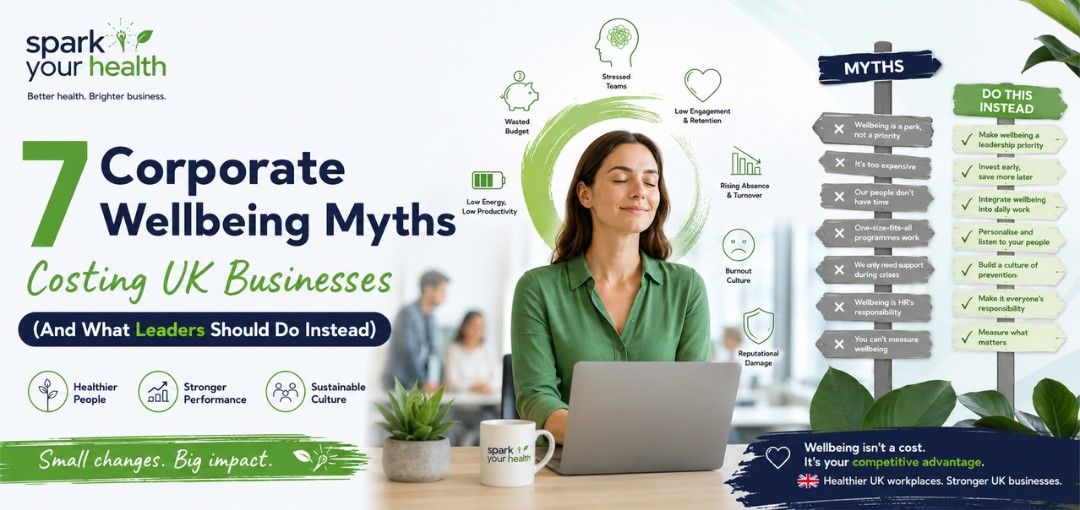
UK businesses collectively spend billions each year on employee wellness. Yet burnout rates keep climbing, absenteeism costs are spiralling, and employee retention remains a persistent headache for HR directors and CEOs alike. The uncomfortable truth? Many organisations are investing in the wrong things — guided by widely accepted corporate wellbeing myths that feel logical on the surface but quietly erode workforce performance.
If your wellbeing budget isn’t delivering measurable results, one (or more) of these myths may be the reason.
📞 Ready to build a wellbeing strategy that actually works? Contact Spark Your Health today: info@sparkyourhealth.co.uk | 0843 289 3468
The Hidden Price of Broken Wellness Strategies
A 2023 Deloitte report estimated that poor mental health costs UK employers approximately £51 billion per year — a figure driven largely by lost productivity, presenteeism, and staff turnover. Despite this, the majority of corporate health programmes still operate on outdated assumptions. Leaders are patching a structural problem with surface-level solutions.
The organisations that outperform their competitors don’t treat wellbeing as a tick-box exercise. They build it into their culture, their leadership model, and their operational strategy. Dismantling these seven myths is where that transformation begins.
Myth 1: Employee Wellbeing Is Just a “Perk” Like Free Fruit or Gym Discounts
This is perhaps the most expensive myth in UK business culture. Wellbeing is not a reward — it is a business infrastructure decision. Offering a fruit bowl or a discounted gym membership might boost morale for a week. It will not reduce chronic stress, prevent burnout symptoms, or build the psychological safety your teams need to perform under pressure.
The real distinction lies between reactive perks and proactive strategy:
| Reactive Perks (Low Business Value) | Proactive Strategy (High Business Value) |
| Free fruit baskets / office snacks | Manageable workloads and realistic deadlines |
| Disconnected annual gym vouchers | Integrated comprehensive corporate health and wellbeing programs |
| Surface-level social events | Psychological safety and clear boundary-setting |
High-performing organisations understand that wellbeing is the foundation of engagement, not a supplement to it. When you build it into your systems and culture, you stop treating symptoms and start preventing them.
Myth 2: Workplace Wellness Programs Only Target Physical Fitness
Physical fitness matters — but it is only one dimension of a resilient workforce. A modern employee wellbeing strategy must address mental, emotional, cognitive, and even financial health. Limiting your programme to step-count challenges and yoga sessions ignores the most costly driver of workplace absenteeism: psychological distress.
The Interdependence of Mental and Physical Health
Chronic stress does not stay in the mind. It triggers inflammatory responses, disrupts sleep, weakens immunity, and increases the risk of cardiovascular disease. When organisations ignore mental health at work, they are inadvertently driving up physical health claims too.
Building Emotional and Cognitive Resilience
Decision fatigue, emotional exhaustion, and cognitive overload are quiet productivity killers — particularly in senior and middle-management roles. An effective occupational health services model addresses resilience training, stress recovery, and emotional regulation alongside physical wellness, creating employees who are sharp, adaptive, and sustainable long-term.
Spark Your Health’s employee wellness program takes a genuinely holistic approach — combining digital tools, expert support, and measurable tracking across all pillars of employee health.

Myth 3: Annual Engagement Surveys Satisfy Your Duty of Care
Important: Under UK HSE stress risk assessment guidelines, employers have a legal duty of care to proactively monitor and manage workplace stress — not just record it once a year.
An annual survey captures a snapshot of how employees felt on one particular Tuesday in November. It misses the team under impossible deadline pressure in March, the manager quietly struggling through Q3, and the remote worker experiencing digital isolation every single day.
To build a wellbeing strategy that meets both ethical and legal standards, leaders should establish continuous feedback loops through three steps:
- Implement real-time sentiment tools that allow anonymous, low-friction reporting throughout the year.
- Train line managers to identify early burnout symptoms and escalate without stigma.
- Formalise the process — implementing a workplace wellness action plan ensures you meet HSE guidelines and creates a clear audit trail of your duty of care obligations.
Annual surveys have their place, but they cannot be your only mechanism. The law and your people — demand more.
Myth 4: Long NHS Wait Times Mean Mental Health Delays Are Unavoidable
This myth has become a dangerous excuse. The NHS is under extraordinary pressure, and waiting months for psychological support is a reality for millions of people. But for businesses, accepting that delay as inevitable is a commercial decision with serious consequences.
A single employee on long-term absence due to untreated mental health issues can cost a business £20,000–£30,000 per year when temporary cover, management time, and lost institutional knowledge are factored in. Multiply that across a workforce, and the cost of inaction becomes undeniable.
Early corporate intervention — through private corporate mental health support, fast-access triage pathways, and embedded mental health first aid — stops issues escalating to crisis point. The return on investment is not theoretical. It is documented, measurable, and significant.
Myth 5: Remote and Hybrid Teams Require Less Wellbeing Oversight
If anything, remote and hybrid working has increased the wellbeing burden — it has simply made it less visible. The absence of physical presence does not mean the absence of stress. It means that stress has nowhere obvious to surface.

The invisible risks of remote work include digital isolation and reduced social connection, unpaid overtime and the collapse of work-life boundaries, screen fatigue and reduced cognitive recovery time, reduced access to informal support from colleagues and managers, and the “always-on” culture that erodes recovery outside working hours.
Leaders who assume that home working reduces pressure are often the last to know when a team member is struggling — by which point the presenteeism cost has already accumulated for weeks or months. Spark Your Health provides tailored corporate wellness for remote UK teams, ensuring that distance doesn’t become a barrier to support.
Myth 6: Corporate Wellness Strategy ROI Is Impossible to Measure
This myth persists because many wellness programmes are not designed with measurement in mind. When you invest in a platform or intervention without defining what success looks like, of course it becomes impossible to track.
A properly structured employee wellbeing strategy generates hard, trackable data:
| Metric Tracked | Without Strategy | With Spark Your Health |
| Absenteeism Days | High temporary staffing costs | Substantial reduction in unplanned absence |
| Presenteeism Rates | Low output, costly errors | High engagement and sustained performance |
| Staff Retention | Recruitment and onboarding spend | Strong talent retention and reduced churn |
| Engagement Scores | Volatile, survey-dependent | Continuous, data-driven insight |
The measurement challenge is not a reason to avoid investing — it is a reason to invest in a programme built around accountability from the start.
Myth 7: Employees Will Automatically Ask for Help If They Need It
This may be the most dangerous myth of all and the one most leaders genuinely believe.
In reality, the employees who most need support are often the least likely to seek it. The most high-functioning, committed team members are frequently the most reluctant to raise their hand. Stigma plays a role, but so does clinical exhaustion: burnout itself erodes the cognitive capacity to take action.
Self-serve portals and generic EAP helplines fail because they place the entire burden of help-seeking onto the individual who is already struggling. A genuinely effective workplace culture — one built on psychological safety and proactive outreach — removes that barrier entirely.
The Spark Your Health platform brings daily wellbeing support directly to employees. No HR referral required, no stigma attached, no corporate hoops to jump through. Support arrives before the crisis does.
Conclusion: Transform Your Wellbeing Strategy Into a Strategic Growth Asset
The organisations winning the talent war in 2024 and beyond share one defining characteristic: they treat employee health as a strategic investment, not a cost centre. Every one of the corporate wellbeing myths explored above represents a gap between what leaders think is working and what their workforce actually needs.
The path forward is not complicated but it does require intention. Replace reactive perks with systemic support. Move from annual surveys to continuous insight. Invest in early mental health intervention rather than absorbing the cost of crisis. And above all, build workplace wellbeing initiatives that reach every employee, regardless of where or how they work.
Stop losing revenue to workplace burnout and outdated perks. Contact the Spark Your Health UK corporate accounts team to schedule an executive consultation — or explore our scalable modern wellbeing activities for a happier UK workplace to start building a more resilient workforce today.
📩 info@sparkyourhealth.co.uk | 📞 0843 289 3468
Frequently Asked Questions
What are the most common corporate wellbeing myths UK businesses believe?
The most damaging include the idea that perks replace strategy, that physical health is the only priority, that annual surveys meet your legal duty of care, and that remote teams need less support. Each carries a real financial cost when left unchallenged.
How does a corporate wellbeing strategy reduce absenteeism?
By addressing root causes — chronic stress, burnout, poor psychological safety — rather than surface symptoms. Businesses with structured employee wellbeing strategies consistently report significant reductions in unplanned absence within 12 months of implementation.
Is employee wellbeing a legal requirement for UK employers?
Under HSE guidelines and existing health and safety law, employers have a clear duty of care to assess and manage work-related stress. A robust workplace stress risk assessment and documented action plan are not optional — they are a legal obligation.
What is presenteeism and why does it matter more than absenteeism?
Presenteeism — being physically or digitally present but mentally disengaged — typically costs UK businesses two to three times more than absenteeism. Employees working through stress or burnout make costly errors, produce low-quality output, and quietly disengage over time.
How quickly can Spark Your Health improve our employee wellbeing metrics?
Most clients begin seeing measurable improvements in engagement and absence metrics within the first quarter. The pace depends on starting conditions and leadership buy-in, but the platform is designed for fast deployment and immediate impact.