
You feel your heart skip. You Google it. Within four minutes, you are convinced it is something serious. An hour later, you are still scrolling, more frightened than when you started.
This is the exhausting, invisible loop that millions of UK adults live inside every single day. Health anxiety symptoms are not imaginary. They are real, physical, and genuinely frightening and that is precisely what makes them so difficult to dismiss. Your body is not lying to you. Your nervous system is simply misfiring.
This guide will help you understand what is actually happening, recognise the patterns, and take back control.
📞 Speak to a Spark Your Health specialist today:
👉 Explore Our Wellbeing Programmes →
What Is Health Anxiety? More Than Just “Worrying”
Health anxiety; clinically referred to as illness anxiety disorder, and historically as hypochondria — is a condition where a person becomes excessively preoccupied with the belief that they are seriously ill, or are about to become ill. It sits at the intersection of psychological fear and very real physical experience.
The Difference Between Healthy Awareness and Illness Anxiety
Paying attention to your body is sensible. Noticing a persistent lump, a mole that changes shape, or a fever that will not break, these warrant medical attention. Healthy awareness is proportionate and action-oriented.
Illness anxiety, by contrast, is disproportionate and cyclical. The person notices a completely normal bodily sensation — a momentary muscle twitch, a brief headache, a slightly elevated pulse and immediately interprets it as evidence of a serious underlying condition. No amount of reassurance fully resolves the fear, and the cycle restarts within hours.
How the Brain Misinterprets Minor Bodily Changes
The human brain is wired for threat detection. Under chronic stress, the brain’s threat-response system becomes hypersensitive, essentially running in a permanent low-level alarm state. This leads to hyper-awareness of normal bodily functions: the gentle gurgling of digestion becomes a sign of bowel disease; a brief dizzy spell becomes a neurological event.
This is not a weakness. It is a nervous system stuck in survival mode, and it has a name — somatic symptom disorder, where psychological distress manifests as genuine, measurable physical sensation.
The Vicious Cycle: How Anxiety Triggers the Exact Symptoms You Fear
Here is the cruel paradox at the heart of health anxiety. The act of worrying about a symptom — chest tightness, heart palpitations, or muscle tension — directly triggers those same sensations through the release of adrenaline and cortisol. You fear a racing heart, so you monitor it constantly. The monitoring itself accelerates your pulse. Your fear deepens. The cycle tightens.
These are phantom physical symptoms triggered by chronic stress — real in sensation, but not rooted in structural disease.
Health Anxiety vs. Social Anxiety: Overlapping Triggers
It is worth noting that health anxiety and social anxiety symptoms share common roots: both involve catastrophic thinking, avoidance behaviours, and an overactive threat response. Many people experience both simultaneously, which is why a whole-person approach to anxiety management is more effective than treating each symptom in isolation.
Red Flags: How to Spot the Key Health Anxiety Symptoms
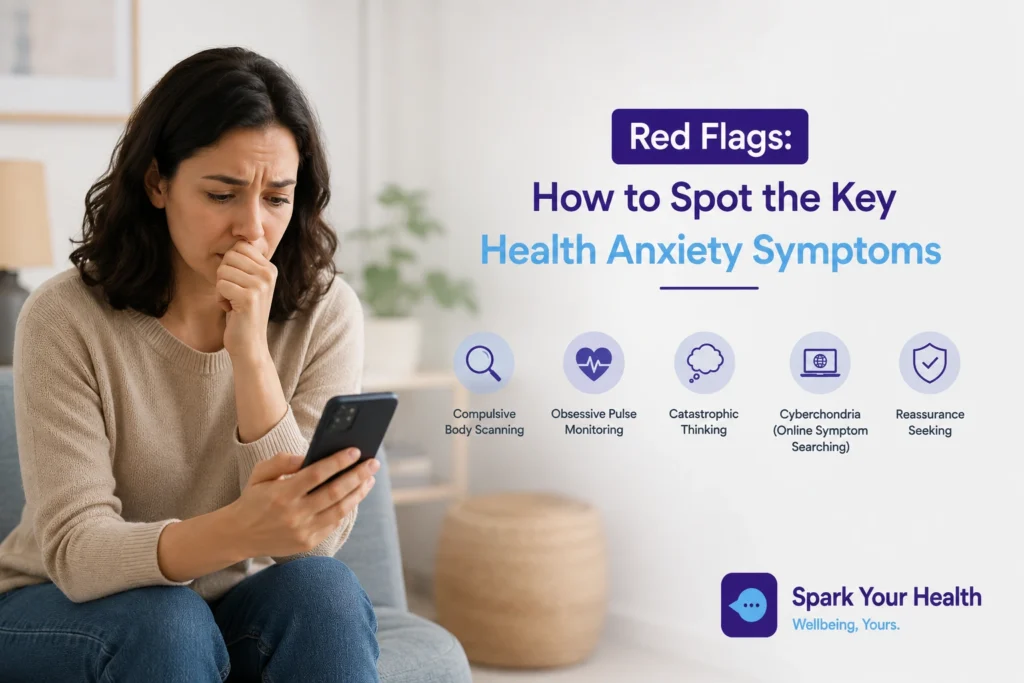
Recognising the pattern is the first step to breaking it. The health anxiety symptoms most commonly reported include compulsive body scanning — the habit of mentally checking each part of the body for pain or abnormality, often multiple times per day. There is also obsessive pulse monitoring, repeatedly pressing fingers to the wrist or neck to verify the heart rate is “normal.”
Cyberchondria is now one of the most significant behavioural markers of the condition. It describes the pattern of obsessive online symptom checking that consistently produces the worst-case diagnosis and elevates the nervous system into full panic. Research from the University of Nottingham found that compulsive health-related internet searches significantly worsen anxiety outcomes rather than resolving them. The person who intended to spend five minutes fact-checking a headache finds themselves deep in rare disease forums at 2am — unable to manage stress before sleep to reduce nighttime anxiety because their cortisol has already spiked beyond control.
Cognitively, health anxiety is characterised by misinterpreting minor physical changes as medical emergencies — the leap from “my arm aches” to “this is a cardiac event” happens in seconds, bypassing rational assessment entirely. This is a reassurance-seeking behavior that temporarily soothes but ultimately reinforces the fear cycle.
Is It Stress or a Medical Issue? Mapping the Physical Triggers
This is the question every person with health anxiety asks — and it deserves a clear, honest answer.
| Somatic Symptom | Driven By Health Anxiety | When to Consult a Doctor |
| Heart palpitations | Spikes during worry, eases with slow breathing | Accompanied by chest pain during physical exertion |
| Muscle tension | Chronic, shifts location, worsens when focused upon | Linked to a specific physical injury or trauma |
| Digestive upset | Flares immediately during health panic episodes | Persistent over weeks regardless of stress levels |
| Headaches | Tension-based, often worsens after symptom checking | Sudden, severe, or accompanied by vision changes |
The distinction between somatic symptom disorder vs. illness anxiety lies largely in persistence and pattern. If symptoms appear during periods of high mental stress and ease during calm, relaxed states, the nervous system is the most likely driver. Always consult your GP if you are uncertain — ruling out physical causes is a legitimate and sensible step, not a sign of weakness.
To identify the hidden physical signs of stress early, pay attention to when symptoms arise, how long they last, and whether they correlate with worry cycles or external pressure.
The True Cost of Health Fears in the Modern Workplace
Health anxiety does not stay at home. It follows people into meetings, into performance reviews, and into their relationships with colleagues.
UK data from the Mental Health Foundation shows that anxiety disorders — including health anxiety — cost UK employers approximately £34.9 billion annually through reduced performance and absenteeism. Employees experiencing chronic health worry report significant difficulty concentrating, frequent short-term absences for GP visits, and a persistent undercurrent of dread that makes focused work nearly impossible.
This is workplace presenteeism driven not by laziness, but by a nervous system in constant emergency mode. For professionals in high-pressure environments, unmanaged health anxiety is one of the fastest routes to full burnout and recognising early signs of burnout at work before they become a crisis is essential. Organisations that embed proactive mental health support through corporate wellbeing programmes consistently report lower anxiety-related absence and stronger team resilience.
👉 Talk to Our Corporate Health Team Today →
Actionable Blueprint: How to Reclaim Your Peace of Mind
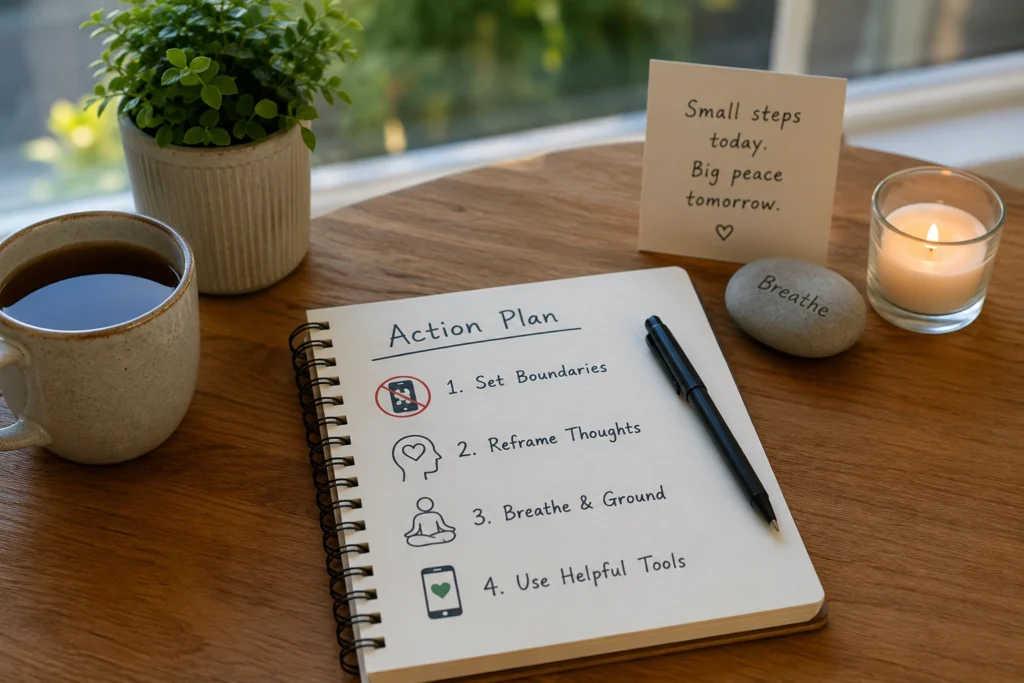
Recovery from health anxiety is entirely possible. It requires consistency, the right tools, and — crucially — a willingness to sit with uncertainty rather than compulsively eliminate it.
1. Implement a Googling Embargo
Set a firm boundary: no symptom searching outside of a scheduled 10-minute window per week, and only on verified medical sources such as NHS.uk. Remove health symptom apps from your phone’s home screen. Each time you resist the urge to search, you weaken the compulsive loop by a measurable degree.
2. Practice Cognitive Behavioural Reframing
Cognitive Behavioral Therapy for hypochondria has the strongest evidence base of any treatment approach, with NICE guidelines recommending it as a first-line intervention. The core technique involves writing down the catastrophic thought, identifying the actual statistical probability of that outcome, and replacing it with a proportionate, evidence-based alternative. Journaling for stress and anxiety relief is a low-barrier entry point into this process and can be started today, without clinical support.
3. Somatic Grounding and Breathing
Somatic grounding techniques and mindfulness work by activating the parasympathetic nervous system — essentially switching off the fight-or-flight response that drives phantom symptoms. The 4-7-8 breathing technique (inhale for 4 counts, hold for 7, exhale for 8) measurably reduces cortisol within minutes. Nervous system regulation tools like cold water exposure, progressive muscle relaxation, and grounding exercises also interrupt the anxiety-sensation feedback loop effectively.
4. Use Vetted Digital Health Tools
Not all wellness apps are created equal. Poorly designed tools can inadvertently reinforce symptom monitoring. Choosing vetted apps for anxiety management built around evidence-based CBT and mindfulness frameworks — rather than symptom trackers — gives you a structured, expert-guided path out of the anxiety loop rather than deeper into it.
Conclusion: Your Health Is Real, and Your Peace Is Recoverable
Health anxiety symptoms are not a character flaw or an overreaction — they are a treatable condition rooted in a nervous system that has learned to misread safety as danger. With the right tools, consistent practice, and expert support, the loop can be broken.
You do not have to navigate this alone. Spark Your Health exists to give you — and your workplace — a clear, compassionate, evidence-backed route forward.
📞 0843 289 3468 | ✉️ info@sparkyourhealth.co.uk
👉 Start Your Wellbeing Journey with Spark Your Health →
Frequently Asked Questions
What are the most common health anxiety symptoms?
The most common signs include compulsive body scanning, obsessive pulse checking, catastrophic interpretation of minor sensations, and cyberchondria — the cycle of frantic online symptom searching that consistently escalates fear rather than resolving it.
Can health anxiety cause real physical symptoms?
It absolutely can. Chest tightness, heart palpitations, muscle tension, and digestive upset are all genuine physiological responses driven by the nervous system’s stress response — not imagination. This is what makes health anxiety so convincing and so distressing.
How is health anxiety different from normal health concern?
Normal concern is proportionate and action-oriented. Health anxiety is cyclical, disproportionate, and resistant to reassurance. The fear persists and restarts even after medical tests return normal results.
What is the most effective treatment for health anxiety?
Cognitive Behavioural Therapy has the strongest clinical evidence base and is recommended by NICE. It is often combined with somatic grounding practices, mindfulness, and — where appropriate — structured digital wellness support.
How does health anxiety affect workplace performance?
It significantly reduces concentration, drives frequent short-term absences, and accelerates burnout. Employees living with unmanaged health anxiety often experience presenteeism — physically at work but mentally consumed by fear — which impacts both personal output and team morale.
Spark Your Health is a UK-based corporate and individual wellbeing platform. We help people and organisations build sustainable health habits through expert-led programmes, digital tools, and workplace wellbeing consultancy. 🌐Visit sparkyourhealth.co.uk