
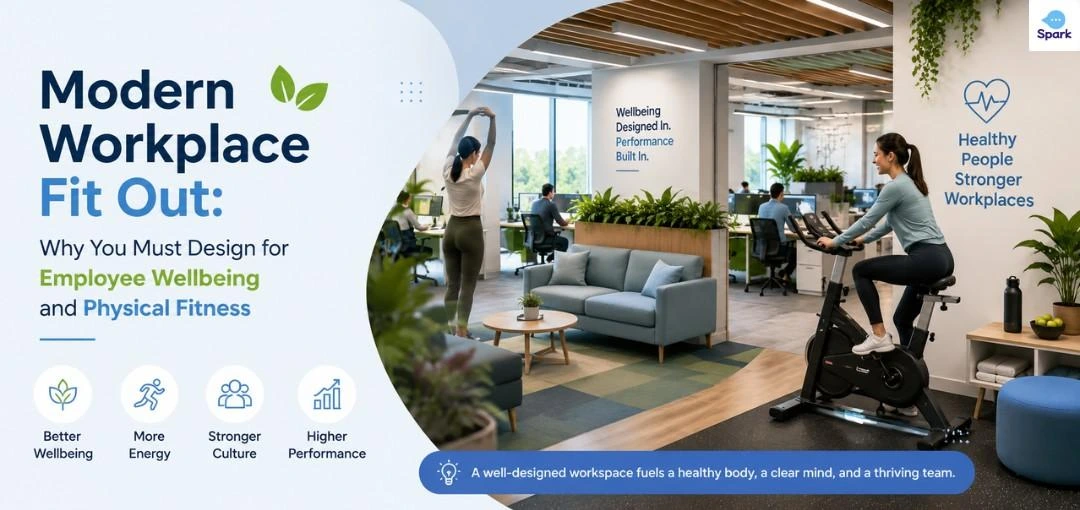
Your office is either working for your people or silently working against them.
A poorly designed workspace doesn’t just look uninspiring. It costs you money. UK businesses lose an estimated £28.3 billion every year to workplace absence and reduced productivity, according to the CIPD’s Health and Wellbeing at Work report. The root cause? Environments that were built for desks, not for people.
A modern workplace fit out is no longer just about aesthetics or space efficiency. It is a strategic investment in your most valuable asset — your employees. When physical space is designed around wellbeing, the business results follow.
📞 Ready to transform your workspace?
Call Spark Your Health today:
0843 289 3468 or email info@sparkyourhealth.co.uk
The Hidden ROI: How Office Design Impacts Your Bottom Line
Most CFOs evaluate a fit-out purely on cost per square foot. The smarter question is: what does a bad office cost us every single quarter?
The answer is more than most leadership teams realise.
Reducing Absenteeism and Presenteeism Through Smart Layouts
Absenteeism, staff not showing up is the visible tip of the iceberg. Presenteeism staff showing up but performing at 30% capacity is far more damaging and far harder to measure. Research from Deloitte found that poor mental health alone costs UK employers up to £45 billion annually, with presenteeism accounting for the largest share.
Office design directly drives both. Poor air quality, static seating arrangements, and harsh artificial lighting all suppress cognitive function and increase stress hormones. A health-conscious workplace fit out attacks these problems at the source rather than masking them with ping-pong tables and free fruit.
Attracting and Retaining Top Talent in a Hybrid World
Post-pandemic employees have options. If your office doesn’t offer a genuinely better experience than their home setup, they will choose to stay home or leave for a competitor who built a space worth commuting to.
Employee retention tactics now include physical design. A LinkedIn Workforce Survey found that 58% of UK professionals would move jobs for better workplace wellbeing support. Your office is a tangible, visible signal of how much you value your people. Make it count.
Essential Elements of a Health-First Commercial Office Renovation
A wellbeing-led commercial office renovation goes deeper than exposed brick and a statement wall. It systematically removes the physical barriers to health that traditional offices bake in by default.
Active Design: Combatting Sedentary Behavior at Work
The average UK office worker sits for over 9 hours a day. Prolonged sitting is now classified as an independent health risk, separate from exercise habits entirely. Reducing sedentary behavior at work should be a primary design brief, not an afterthought.
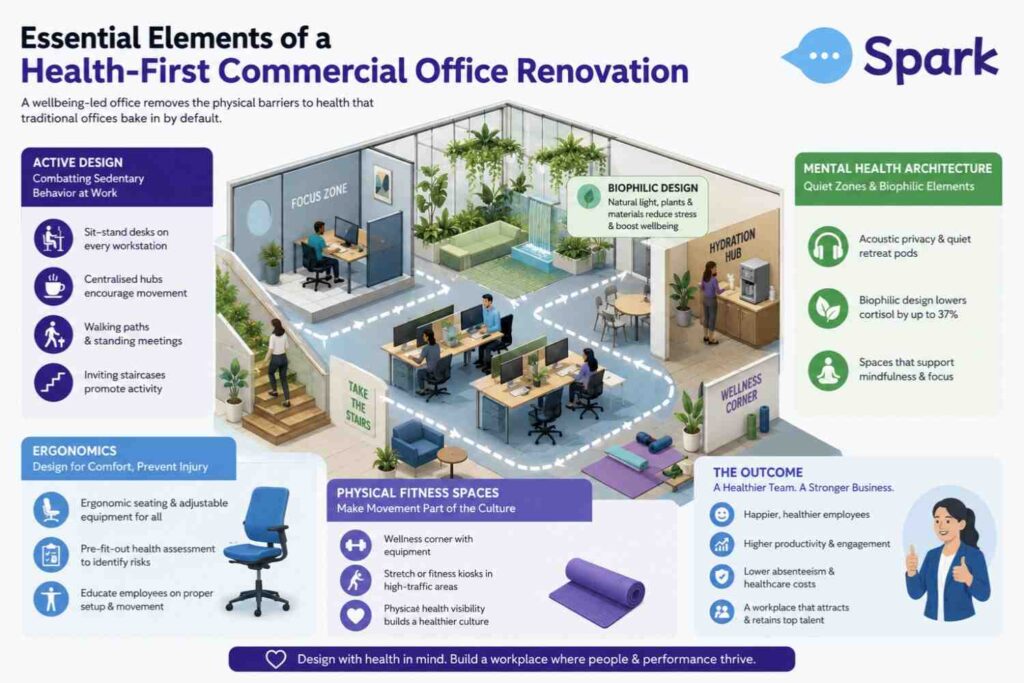
Active workplace layout principles that work:
- Sit-stand desks on every workstation, not just a few “wellness” stations employees feel self-conscious using
- Centralised water and coffee hubs — placed deliberately away from desks to force regular movement
- Perimeter walking paths within larger open-plan floors, encouraging informal standing meetings and movement breaks
- Staircase activation — making stairs more inviting, better lit, and visually engaging than the lift
Small design shifts like these embed movement into the working day without requiring any willpower from staff. That is the power of environmental design.
Mental Health Architecture: Quiet Zones and Biophilic Elements
Not every task requires collaboration. Yet most modern open-plan offices make it nearly impossible to think deeply, work quietly, or simply decompress for five minutes. This is a design failure with real consequences for workplace mental health design.
Acoustic privacy panels, soft-furnished retreat pods, and designated focus zones give employees cognitive control — a primary driver of stress reduction. Implementing a physical layout that encourages quiet reflection can also support how to practice mindfulness at work routines that HR teams are actively trying to embed into daily culture.
Biophilic office design — integrating natural light, indoor planting, water features, and natural materials reduces cortisol levels by up to 37%, according to research published in the Journal of Environmental Psychology. It is one of the highest-impact, lowest-cost interventions available in any fit-out budget. Workspaces that lack natural light can worsen staff stress, making it consistently harder for HR to help employees manage anxiety naturally in the long run.
Ergonomics and Physical Fitness Spaces
Ergonomic office design reduces musculoskeletal complaints — the single largest cause of workplace absence in the UK. Here is how to build it properly:
- Conduct an occupational health assessment before the fit-out begins to identify current injury patterns and risk areas across your workforce
- Invest in fully adjustable ergonomic seating, monitor arms, and keyboard trays as standard — not optional upgrades
- Designate a dedicated active wellness corner: a small area with foam rollers, resistance bands, and a yoga mat that signals physical health is part of your culture
- Consider digital fitness kiosks or guided stretch stations in high-traffic areas like kitchen or lift lobbies
- Brief all employees on how to use new equipment — the best ergonomic chair in the world is useless without proper setup
Aligning Your Physical Office Fit Out with Digital Health Initiatives
Here is a truth that many workplace designers miss: a beautifully renovated office will underperform if your employees’ daily habits haven’t changed alongside it.
Corporate space planning sets the stage. But culture fills it. The most successful UK organisations pairing their office fit out with structured employee wellbeing programs are seeing measurably better outcomes, higher engagement scores, lower sickness rates, and stronger performance data.
Digital layers that complement physical design include:
- Corporate health tracking apps that run team step challenges and hydration goals
- Workplace lifestyle coaching integrated into your HR platform
- Employee wellness initiatives like digital mindfulness programmes or live fitness classes accessible from the office or home
- While organising an annual wellness retreat boosts morale temporarily, it is the daily physical environment that drives sustainable behaviour change
HR workplace strategy is most effective when the physical and digital environments are designed together from day one not bolted together after the fit-out is complete.
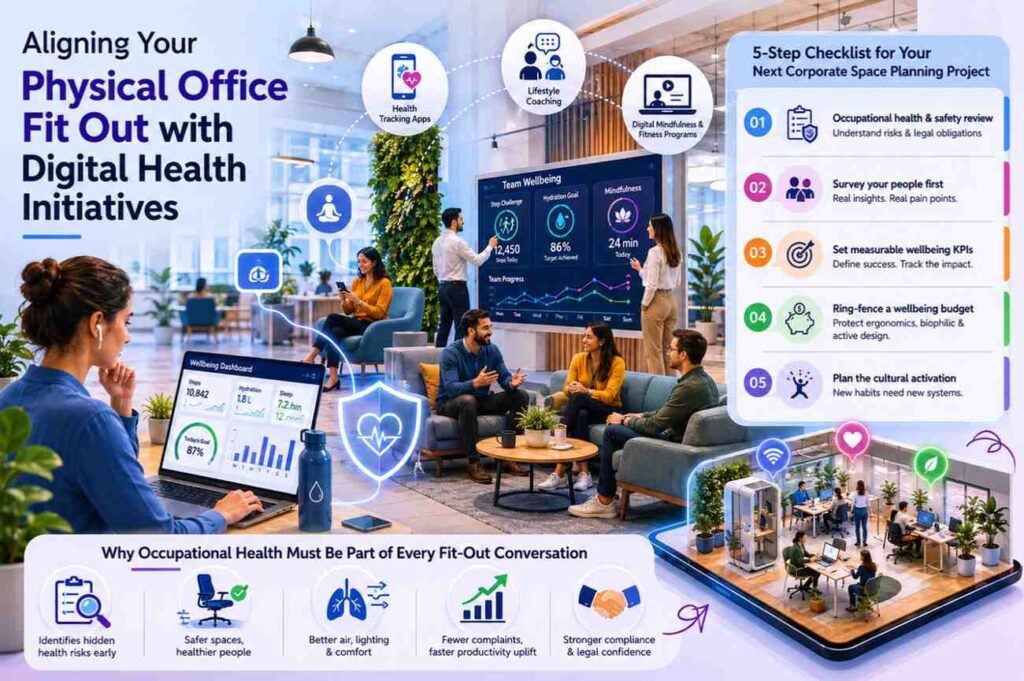
The 5-Step Checklist for Your Next Corporate Space Planning Project
Before your project manager signs off on a single floorplan, run through this:
- Commission an occupational health and safety compliance review — understand your legal obligations and current workforce health risks before a single wall is moved
- Survey your people first — anonymous pulse surveys identifying pain points (noise, light, temperature, movement) give you a design brief grounded in real data, not assumptions
- Set measurable wellbeing KPIs — define what success looks like: a 15% reduction in sickness days, improved eNPS scores, increased step counts. If you can’t measure it, you can’t prove the ROI
- Ring-fence a wellbeing budget line — ergonomics, biophilic elements, and active design features are frequently cut in value engineering. Protect them
- Plan the cultural activation — brief your employee wellness program partner before day one in the new space. New habits need new systems, not just new surroundings
Why Occupational Health Must Be Part of Every Fit-Out Conversation
This point does not get enough airtime in design briefs.
Occupational health and safety compliance is not a box-ticking exercise. It is the foundation of a workspace that genuinely protects people. Before you commission a new layout, a formal assessment surfaces the physical risk factors already affecting your team from repetitive strain risks to ventilation issues and gives your designers a health-first mandate rather than a purely aesthetic one.
Organisations that embed occupational health into their planning process report fewer post-renovation complaints, faster productivity uplift, and stronger legal standing. It is the smartest investment you can make at the start of a project.
Transform Your Workplace from the Inside Out
Your physical office is a statement of intent. It tells every employee, every candidate, and every client exactly how much you value human performance and dignity at work.
A wellbeing-led workplace fit out is the most visible, lasting investment a UK business can make in its people — but it only delivers its full return when paired with the right culture, the right habits, and the right health partner.
🌟 Ready to Build a Workplace That Works for Your People?
Planning an office move or redesign?
Download our free Workplace Wellbeing & Ergonomics Design Blueprint — a practical framework used by UK HR teams to ensure health is protected at every stage of the fit-out process.
Or speak directly with our corporate health specialists today.
📞 0843 289 3468 ✉️ info@sparkyourhealth.co.uk
FAQ’s
What is a wellbeing-led workplace fit out?
It is a commercial office renovation where employee physical and mental health are treated as primary design objectives — every element, from lighting to ergonomics, is chosen for its measurable impact on people.
How does office design reduce absenteeism?
Yes, directly. Better air quality, natural light, and active design features lower the biological and psychological triggers of illness, resulting in consistently fewer sick days.
Is biophilic office design worth the investment?
Absolutely — studies show employees in biophilic workspaces report lower stress and higher concentration. With plants and natural materials being relatively low cost, the ROI is among the strongest in any fit-out budget.
How do we measure the ROI of a health-first office redesign?
Yes, it is fully measurable. Track sickness absence, eNPS scores, productivity, and staff turnover before and after. Companies that set KPIs upfront typically see clear returns within 12–18 months.
Can an office fit out really help with employee retention?
In today’s hybrid world, your office must justify the commute. A wellbeing-focused workspace is a powerful retention signal — especially for high-performing talent with options.
Spark Your Health is a UK-based corporate health and wellbeing platform helping organisations build healthier, more productive workforces. From digital wellness programs to expert-led workplace consultancy, we partner with HR teams and leadership to make wellbeing a business strategy, not a benefit.